Two MBBR media samples can look identical on a supplier’s spec sheet. But when you dig into the material — polymer chain structure, filler content, mechanical properties — the differences in real-world performance can be substantial. This article covers three areas where recycled-content MBBR media differs from virgin HDPE, supported by published research and field observations.
This is the reality of MBBR biofilm carrier procurement. Open any B2B marketplace and you’ll find similar-looking products at a wide range of prices. Both may claim “virgin HDPE.” The price gap, however, often reflects underlying differences in material quality that affect long-term performance.
I’ve spent most of my career designing and commissioning MBBR systems. Over that time, I’ve evaluated media from dozens of suppliers across four continents. The purpose of this article is not to sell a particular product, but to share the technical framework I use to assess media quality — what parameters matter, what the research shows, and how to verify supplier claims.
Below, we examine three areas where material composition makes a measurable difference, followed by practical verification methods that can be used during supplier evaluation.
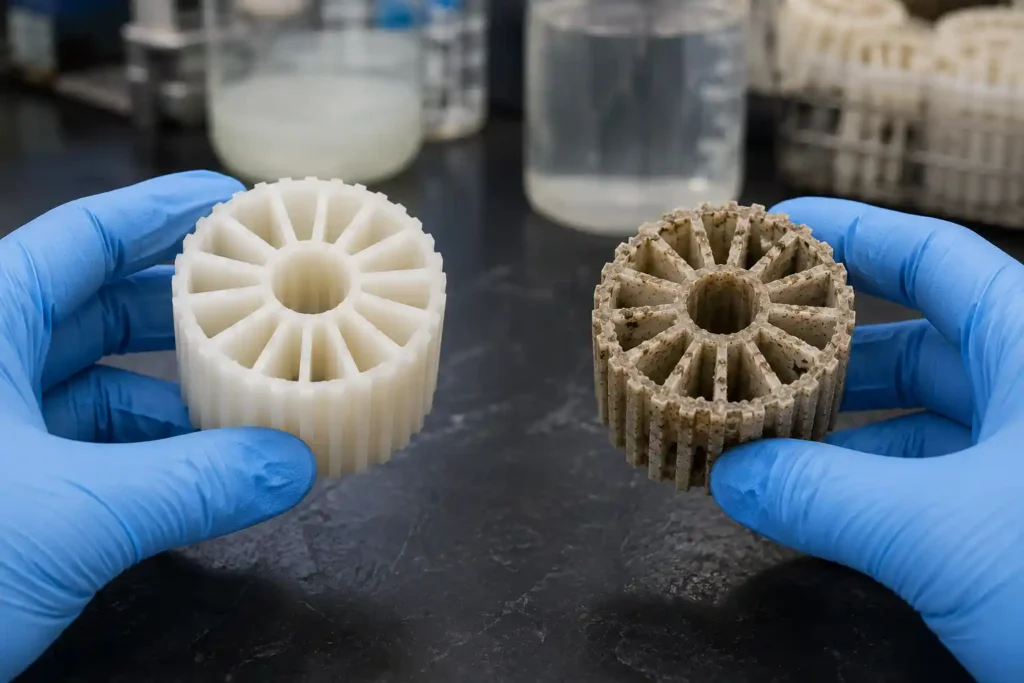
1. Mechanical Property Differences: What the Data Shows
The fundamental difference between virgin and recycled HDPE lies in polymer chain integrity. Virgin HDPE consists of long, intact polymer chains that provide mechanical strength. Recycled HDPE has been through at least one reprocessing cycle, which causes chain scission — shortening the polymer chains and reducing material strength.
A peer-reviewed study by Tesfaw et al. (2022) systematically compared the mechanical properties of virgin and recycled HDPE across 11 blend ratios. The results under controlled lab conditions were as follows:
| Blend Ratio (Virgin : Recycled) | Tensile Strength (MPa) | Change vs. 100% Virgin |
|---|---|---|
| 100 : 0 (Fully Virgin) | 20.67 | — |
| 90 : 10 | 20.03 | -3.1% |
| 80 : 20 | 18.69 | -9.6% |
| 70 : 30 | 18.16 | -12.1% |
| 60 : 40 | 14.83 | -28.3% |
| 50 : 50 | 12.68 | -38.7% |
| 0 : 100 (Fully Recycled) | 7.73 | -62.6% |
Note: These results are from controlled laboratory testing. Real-world performance depends on operating conditions, wastewater chemistry, and the specific quality of recycled feedstock used by each manufacturer.
A separate consideration is the use of calcium carbonate (CaCO₃) filler. At low loading levels, CaCO₃ can improve certain properties of HDPE. However, at higher loading levels — which are common in low-cost recycled media — the filler creates stress concentration points within the polymer matrix. Research by Bartczak et al. (1999) showed that at high filler volume fractions, CaCO₃ particles can act as points where cracks initiate under repeated loading. This is particularly relevant for MBBR applications where media is continuously agitated by aeration.
2. Long-Term Degradation Profile
In continuous MBBR service, media is subjected to sustained mechanical stress — tumbling against other carriers, aeration shear forces, and chemical exposure. The degradation rate of virgin HDPE is well understood and predictable. The material has a documented track record of structural integrity for 15 to 20 years under normal operating conditions — a standard widely referenced across the MBBR industry.
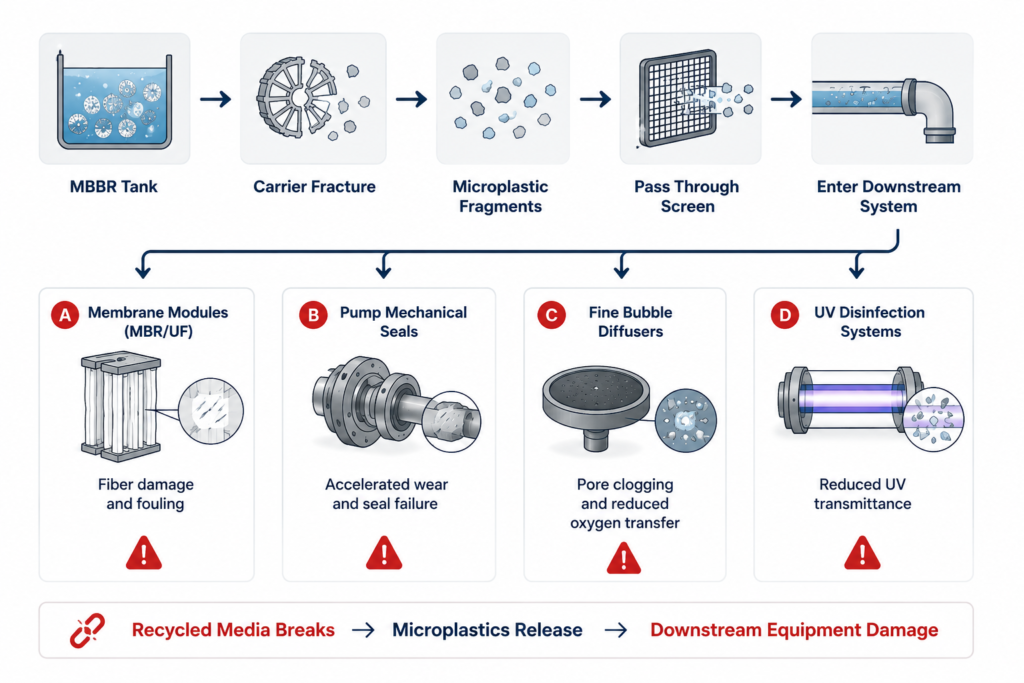
Media manufactured with recycled HDPE or high CaCO₃ filler content follows a different trajectory. The weakened polymer matrix is more susceptible to micro-crack formation at stress concentration points — particularly along the fins and edges of the carrier geometry. Once formed, these cracks can propagate under continued mechanical loading, eventually leading to material loss.
The accelerated degradation can manifest in several ways that affect plant operations:
- Mass loss: Carriers shed material over time, reducing the effective surface area available for biofilm growth and treatment capacity.
- Loss of fluidization: Fragmented carriers have altered hydrodynamic properties. They may not fluidize properly, creating dead zones in the reactor.
- Downstream interaction: Small plastic fragments that pass through retention screens have been shown in recent research to interact with downstream membrane systems and other process equipment. While the magnitude of the effect depends on many site-specific factors, it is a consideration that engineering teams should be aware of when evaluating media quality.
The table below summarizes the typical differences observed between virgin and recycled-content media across key physical and operational parameters:
| Parameter | Virgin HDPE | Recycled-Content Media |
|---|---|---|
| Polymer chain integrity | Long chains; consistent batch-to-batch | Shortened chains; variable with feedstock source |
| Fracture behavior under load | Ductile deformation before failure | Can show brittle fracture with high filler content |
| Expected service life | 15–20 years | Variable; significantly reduced in many cases |
| Density consistency | ±0.01 g/cm3 across batches | Can vary >0.02 g/cm3 with filler content |
| Downstream equipment risk | Minimal | Potentially higher with brittle degradation |
3. Lifecycle Cost Implications
The initial purchase price of MBBR media tells only part of the cost story. A more complete assessment also accounts for replacement frequency, process reliability, and downstream maintenance. For a typical industrial MBBR installation, the price difference between virgin and recycled-content media may be in the range of $300–$800 per cubic meter — which can represent a meaningful initial saving on paper.
However, that saving needs to be evaluated against the expected service life difference. If virgin HDPE media lasts 15–20 years while recycled-content media requires replacement in 3–8 years (depending on material quality and operating conditions), the lifecycle cost calculation shifts significantly. The cost of media replacement includes not just the purchase price of new media, but also the labor and downtime required for the replacement process — which for a typical industrial system can take 2–4 weeks depending on reactor configuration and access constraints.
From a risk management perspective, many engineering firms and plant owners specify virgin HDPE media specifically because it removes the uncertainty around material degradation. The incremental upfront cost is treated as an insurance premium against unplanned maintenance and potential downstream issues. For a plant that serves a municipal population or an industrial facility with strict discharge limits, a media failure event that compromises treatment performance carries compliance and reputational costs that go far beyond the replacement media itself.
How to Verify MBBR Media Material Quality
The most reliable way to assess media quality is through standardized testing and documentation review. Below are three practical approaches, ranging from a quick field screening to comprehensive lab verification.
Field Screening: Visual Fracture Assessment
A simple mechanical test — applying increasing pressure to a sample carrier using a bench vise — can provide a preliminary indication of material characteristics. Virgin HDPE typically deforms ductilely before fracturing. Material with significant CaCO₃ filler content may fracture more abruptly, sometimes leaving a white powdery residue at the break point (the exposed filler). This is not a substitute for standardized testing, but it can flag potential issues for further investigation.
Important: This is a rough field screening method only. It provides indications, not conclusions. Formal material qualification requires standardized tests as described below.
Standardized Density Measurement
Virgin HDPE has a consistent density of 0.94–0.97 g/cm³ when measured per ASTM D792 or ISO 1183. CaCO₃ filler increases density. A batch showing density variation greater than 0.02 g/cm³ between samples is a red flag that warrants further investigation. Request the density test report from your supplier and verify the test method used.
Material Documentation Review
Reputable MBBR media suppliers provide Material Safety Data Sheets (MSDS) and Certificates of Analysis (CoA) from their resin manufacturer. Our supplier verification checklist provides a structured framework for reviewing these documents, including what to look for on each certificate and what constitutes acceptable documentation.
Making an Informed Procurement Decision
Material selection for MBBR media is ultimately a decision that balances upfront cost against long-term performance expectations. Virgin HDPE offers proven, predictable material properties with a documented 15–20 year service life. Recycled-content media may offer initial cost savings, but the trade-offs in mechanical properties and service life should be carefully evaluated based on the specific requirements of each project.
For plants where treatment reliability, regulatory compliance, and predictable maintenance are the priority — which covers the majority of municipal and industrial installations — virgin HDPE media remains the industry standard specification for good reason.
Every Vorexwater carrier is manufactured from 100% virgin HDPE with no CaCO₃ fillers, no regrind, and no reprocessed content. Material certification is available for every production batch.