
Fine Bubble Disc Diffusers
Fine bubble disc diffusers are the most widely used aeration device in modern wastewater treatment plants. They produce small bubbles (1–3 mm diameter) that rise slowly through the tank, maximizing oxygen transfer efficiency while keeping energy costs under control.
Choosing the right disc diffuser — size, membrane material, and layout — directly affects your aeration system’s SOTE (Standard Oxygen Transfer Efficiency), energy consumption, and long-term maintenance costs.
This guide covers our full range of fine bubble disc diffusers, how they compare, and how to select the right one for your project.
What Is a Fine Bubble Disc Diffuser?
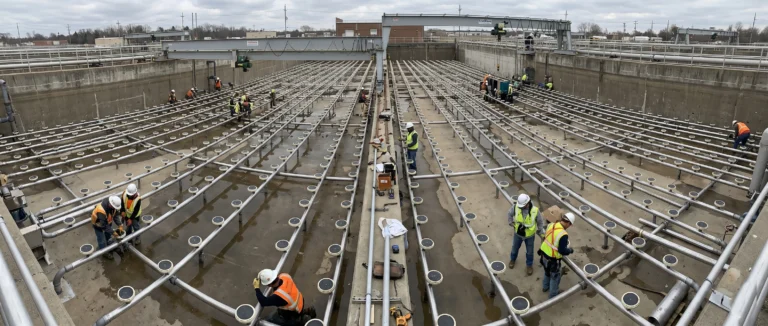
A fine bubble disc diffuser is a circular aeration device installed at the bottom of a biological treatment tank. Compressed air passes through a flexible membrane with thousands of micro-perforations, producing very small bubbles that rise through the water column.
These small bubbles have a high surface-area-to-volume ratio, which means oxygen transfers into the water much more efficiently than large bubbles — typically 25–35% SOTE at 5-metre water depth, compared to 6–12% for coarse bubble systems.
A complete disc diffuser unit consists of three parts:
- Membrane — The perforated flexible sheet that produces the bubbles (EPDM, Silicone, or PU)
- Base plate / Support disc — Rigid plastic backing that holds the membrane
- Threaded connector — ¾” or 1″ BSP thread to connect to the air distribution pipework
Role in the Aeration System
Disc diffusers are the business end of the aeration system. They determine how much oxygen reaches your biomass — and at what energy cost.
- Oxygen transfer — Fine bubbles provide 3–5× more oxygen per unit of air than coarse bubbles
- Mixing & fluidization — In MBBR systems, the rising bubble plume keeps media suspended in the reactor
- Energy consumption — Aeration typically accounts for 50–70% of a WWTP’s electricity bill; better diffusers = lower operating costs
- Reliability — Quality EPDM membranes last 3–5 years before replacement, with consistent SOTE throughout their life
System Thinking: Disc diffusers are part of a complete aeration system. They work with air distribution piping, blowers, and control valves. A well-designed Aeration System matches diffuser layout with blower capacity and tank geometry for optimal efficiency.
Disc Diffuser Comparison Table
Below is a head-to-head comparison across all our disc diffuser models. Use it as your starting point, then read the detailed guidance below.
| Parameter | 7" VX-DD-215 | 9" VX-DD-270 | 12" VX-DD-300 |
|---|---|---|---|
| Outer diameter | 215 mm (≈7") | 270 mm (≈9") | 300 mm (≈12") |
| Effective aeration area | ∼310 cm² | ∼500 cm² | ∼630 cm² |
| Recommended air flow | 0.5–3.5 m³/h | 1.0–5.0 m³/h | 1.5–6.0 m³/h |
| SOTE (4 mm perf, 5 m depth) | 28–32% | 28–35% | 28–35% |
| Membrane options | EPDMSilicone | EPDMSilicone | EPDM |
| Connection thread | ¾" BSP | 1" BSP | 1" BSP |
| Standard membrane perforations | 4,000+ | 6,500+ | 8,000+ |
| Warranty | 2 years | 2 years | 2 years |
| Best suited for | Small tanks, RAS, shallow basins | Standard WWTP, medium depth | Large basins, high air demand |
Pro Tip: For most municipal and general industrial applications, EPDM is the most cost-effective choice. Switch to Silicone only when your wastewater consistently exceeds 80°C or contains solvents that degrade EPDM. If your effluent has high fat/oil/grease (FOG) content, choose PU.
How to Choose the Right Disc Diffuser
Three factors drive the decision: tank geometry (which determines diffuser size and count), wastewater characteristics (which determines membrane material), and air supply capacity (which determines how many diffusers you can feed).
Start with your tank depth and required air flow per diffuser:
| If your project looks like... | Start here | Also consider |
|---|---|---|
| Shallow tank (<4 m), RAS, small package plant | 7" | Lower air flow per unit — more diffusers at lower density |
| Standard municipal WWTP, tank depth 4–6 m | 9" EPDM | 12" if peak air demand is high |
| Large basin, deep tank (>6 m), high SOTE target | 12" EPDM | 9" as alternative, higher density layout |
| High-temperature industrial effluent (>80°C) | Silicone membrane | Any size, based on tank geometry |
| High FOG / grease-laden wastewater | PU membrane | — |
| Retrofit of existing diffuser grid | Match existing connection size | Can often upgrade from coarse bubble to fine bubble for 30–50% energy savings |
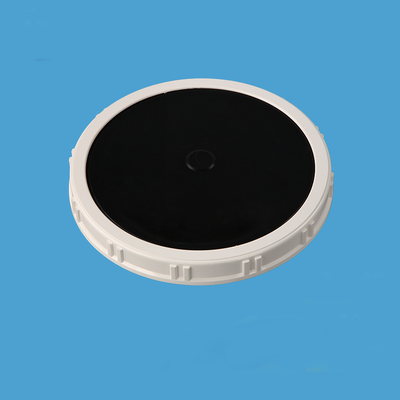
Our smallest disc diffuser. Best for installations where space is limited or air demand per diffuser is low.
The most popular size for municipal and industrial WWTPs. Balances air flow capacity, SOTE, and cost per unit of oxygen transferred.
Our largest disc diffuser. Delivers the highest air flow per unit, reducing the number of diffusers and the amount of pipework needed in large basins.
Factors That Affect Your Choice
| Factor | Why it matters |
|---|---|
| Tank depth | Deeper tanks = higher hydrostatic pressure = more oxygen dissolves per bubble. Disc diffusers in tanks >6 m should be sized to handle higher backpressure. |
| Oxygen demand (SOTR) | Higher SOTR needs more diffusers or larger diffusers. Calculate total air flow required first, then decide on diffuser count vs size. |
| Diffuser density | Typically 15–35% floor coverage. Too few diffusers causes poor mixing; too many wastes pipework. The right density depends on tank geometry and air flow per diffuser. |
| Wastewater chemistry | FOG, solvents, high temperature, and aggressive chemicals all degrade membrane materials differently — choose EPDM, Silicone, or PU accordingly. |
| Blower pressure capacity | Diffuser depth + pipe losses + membrane pressure drop must be within your blower's operating range. Fine bubble membranes add 2–5 kPa backpressure. |
| Installation & maintenance | Larger diffusers (12") mean fewer connections but heavier individual units. Consider access for membrane replacement when designing the grid layout. |
Categories
Tell us about your project
Tank dimensions, target oxygen demand, wastewater type — and we’ll recommend the right diffuser size, membrane material, and layout.
FAQ: Common Questions About MBBR Media
How long do fine bubble disc diffuser membranes last?
EPDM and Silicone membranes typically last 3–5 years in continuous operation. PU membranes 2–4 years. Actual lifespan depends on wastewater chemistry, temperature, and whether the aeration system cycles on/off frequently (cycling accelerates wear). Regular inspection every 12 months is recommended.
What's the difference between fine bubble and coarse bubble diffusers?
Fine bubble diffusers produce bubbles of 1–3 mm diameter with SOTE of 25–35% at 5 metres depth. Coarse bubble diffusers produce 6–10 mm bubbles with SOTE of 6–12%. Fine bubble is 3–5× more efficient for oxygen transfer, but requires cleaner air (filtration to remove particulates that could clog the membrane pores). See our Coarse Bubble Diffusers for comparative details.
How do I know when to replace the membrane?
Three signs: (1) visible tears, holes, or stiffening of the membrane, (2) increasing backpressure at the blower (membranes stiffen with age), (3) declining DO levels at the same air flow rate, indicating the membrane pores have enlarged or are clogged.
Does diffuser layout affect SOTE?
Yes — significantly. Even diffuser coverage across the tank floor ensures the rising bubble plume mixes the entire basin. Sparse or uneven layouts create dead zones where DO is low, even if total air flow is adequate. Typical coverage is 15–35% of the basin floor area.