MBBR stands for Moving Bed Biofilm Reactor — a biological wastewater treatment process where microorganisms grow as a biofilm on plastic carriers inside the reactor rather than being suspended in the mixed liquor. This design decouples biomass retention from hydraulic flow, and that single change alters the fundamental constraints of biological treatment.
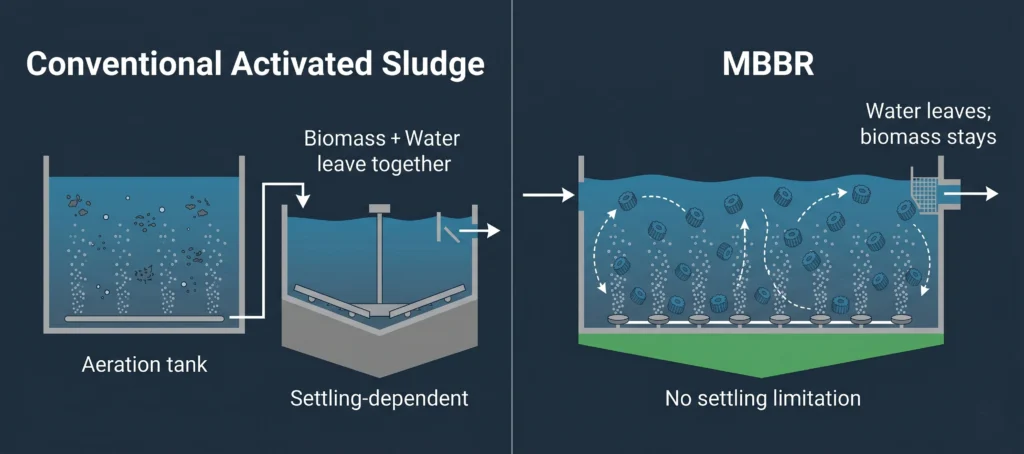
The conventional activated sludge process has a fundamental limitation: biomass and treated water leave the tank together. Settling determines whether the biomass returns or is wasted. This coupling of biological performance with solids separation creates inherent constraints on how much biomass the system can hold, how it responds to load changes, and how large the tanks must be.
MBBR breaks that coupling. By growing biomass on carriers that stay in the tank, it changes what is possible in biological wastewater treatment.
The Concept: Decoupling Biomass from Flow
Every biological treatment system needs two things: microorganisms to consume pollutants, and a way to keep those microorganisms in contact with the wastewater long enough for treatment to occur.
In a conventional activated sludge system, microorganisms are suspended in the mixed liquor. The treated water and biomass flow together to a clarifier, where solids settle by gravity. Some biomass is returned to the aeration tank; some is wasted. The system works, but it imposes a hard trade-off: if you want more biomass (for better treatment or higher capacity), you need better settling, which means larger clarifiers and lower overflow rates.
MBBR eliminates this trade-off by attaching the biomass to carriers that are physically retained in the reactor by a mesh screen. The water leaves; the biomass stays. This means the system can maintain a high biomass concentration regardless of the hydraulic flow rate, because the two are no longer linked through a clarifier.
This decoupling has three immediate practical consequences:
- Higher effective biomass — MBBR systems typically maintain 3,000–5,000 mg/L of biofilm mass, comparable to or higher than conventional activated sludge, without any risk of solids washout
- No return sludge pumping — The biomass is already where it needs to be
- Smaller tank volume — Treatment occurs in a smaller space because biomass retention is independent of settling
System Components
An MBBR system has four essential elements.
The Reactor Basin
The tank can be rectangular or circular, concrete or steel. Unlike activated sludge basins, MBBR reactors do not require a separate clarification zone because solids separation happens downstream. The basin geometry must ensure uniform carrier distribution without dead zones. Length-to-width ratios of 0.5:1 to 1.5:1 are typical.
Biofilm Carriers
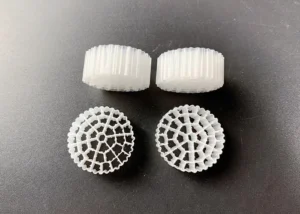
The carriers are small, free-floating shapes made from virgin high-density polyethylene (HDPE) with a density of approximately 0.95 g/cm³ — slightly less than water. When biofilm grows on the surface, the overall density approaches 1.0 g/cm³, allowing the carriers to remain suspended with minimal energy input.
The most common carrier designs include cylindrical shapes with internal fins (K1, K3, K5), flat chip designs, and saddle-shaped media. The internal structures create protected surfaces where biofilm grows, shielded from excessive shear forces. Specific surface area ranges from 350 m²/m³ for standard carriers to over 3,000 m²/m³ for advanced flat chip designs. (For a detailed comparison of carrier types and how to verify their specifications, see our guide on MBBR media types and specification verification.)
The carriers occupy 30–60% of the reactor volume — known as the fill fraction. The upper practical limit is approximately 67% fill; beyond this, carriers cannot fluidize properly and treatment efficiency declines.
Aeration Grid (Aerobic Reactors)
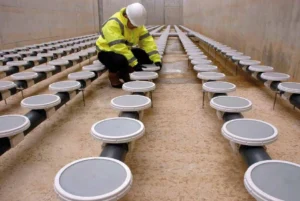
The aeration system serves two functions simultaneously: supplying oxygen for biological treatment and keeping the carriers fluidized. Fine bubble diffusers are standard, installed at the tank bottom in a grid pattern matched to the basin geometry. The air flow rate must be sufficient to maintain the entire carrier bed in motion — localized dead zones lead to carrier accumulation and reduced treatment volume.
Retention Screen
A mesh screen at the reactor outlet prevents carriers from escaping while allowing treated water to pass through. Sieve openings must be smaller than the smallest carrier dimension. Proper screen design is critical: if screens clog or are undersized, hydraulic bottlenecks develop. The three main types are cylindrical wedge-wire screens, flat panel screens, and rotating drum screens.
How It Works: The Process
Wastewater enters the reactor and mixes with the fluidized carrier bed. Microorganisms in the biofilm consume organic matter and nutrients, using oxygen supplied by the aeration system.
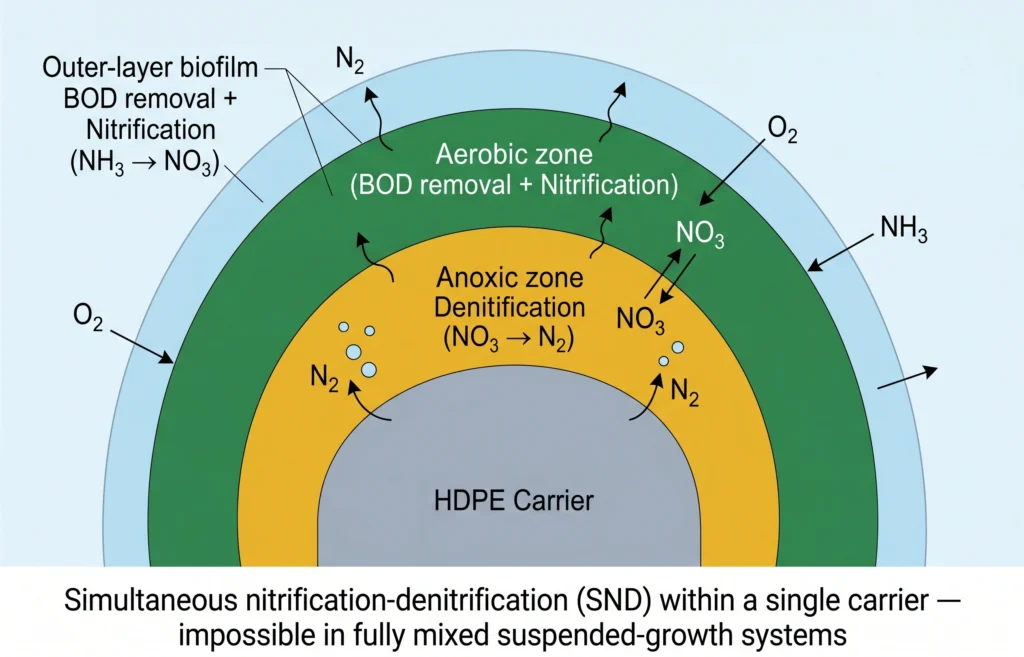
The biofilm develops in layers. The outer layer, in direct contact with the bulk liquid, contains aerobic organisms that consume BOD and oxidize ammonia. Deeper layers, where oxygen is depleted, can support anoxic organisms that reduce nitrate to nitrogen gas. This layered structure enables simultaneous nitrification and denitrification within a single carrier — something impossible in a fully mixed suspended-growth system.
As the biofilm thickens, shear forces from carrier-to-carrier collisions and water turbulence naturally remove excess biomass. The sloughed biofilm exits with the treated water and is removed in a downstream clarifier or dissolved air flotation unit. No backwashing is required.
The system operates continuously. There are no settling phases, no decant cycles, no return sludge pumps. The only moving parts are the blowers supplying air to the diffusers.
Design Parameters
MBBR systems are designed around two key parameters: hydraulic retention time and fill fraction.
Hydraulic retention time typically ranges from 3–8 hours for municipal wastewater, depending on the treatment objective. BOD removal requires the shortest HRT; nitrification requires longer contact time because nitrifying bacteria grow more slowly. Temperature is a critical input — design HRT at 10°C may be twice what is required at 20°C.
The fill fraction determines the total surface area available for biofilm growth. A 50% fill fraction with standard K3 media (500 m²/m³ specific surface area) provides 250 m² of biofilm surface per cubic meter of reactor volume. Increasing the fill fraction increases treatment capacity up to the fluidization limit.
These two parameters — HRT and fill fraction — allow the designer to match the system precisely to the required treatment capacity and effluent quality, without the settling constraints that limit conventional systems.
Sludge production in MBBR is lower than in activated sludge systems. Typical yield ranges from 0.3–0.5 kg TSS per kg BOD removed, compared to 0.5–0.7 kg TSS/kg BOD for conventional suspended growth. The extended sludge retention time in biofilm systems promotes endogenous respiration, and the sludge that is produced is denser and settles more readily than activated sludge floc.
What MBBR Does Well
MBBR excels in several areas where suspended-growth systems struggle.
Resilience to shock loads. The biofilm structure protects microorganisms from hydraulic surges and toxic events. Because the biomass is attached, it cannot be washed out by high flows. Facilities treating industrial wastewater with variable organic loads benefit significantly from this characteristic.
Low-temperature performance. Biofilm systems maintain higher activity at low temperatures than suspended-growth systems. MBBR installations in Scandinavia and cold-climate regions have demonstrated reliable nitrification at wastewater temperatures as low as 4°C.
Simple operation. Once the system is commissioned and the biofilm is established, operation requires primarily dissolved oxygen monitoring and routine blower maintenance. There is no return sludge ratio to manage, no sludge volume index to track, and no membrane cleaning protocol to follow.
Easy retrofit. Existing activated sludge tanks can be converted to MBBR by adding carriers and installing retention screens. A typical conversion involves draining the basin, installing the retention screens and aeration grid, filling with carriers, and seeding the biofilm — all within a standard maintenance shutdown. This is often the fastest and most cost-effective way to increase treatment capacity at an existing plant without constructing new tanks. (See our MBBR vs MBR vs SBR comparison for how MBBR fits against alternative technologies.)
What MBBR Does Not Do Well
MBBR cannot produce effluent suitable for direct reuse without additional treatment. The process does not inherently remove suspended solids — downstream clarification or filtration is always required. For applications requiring TSS below 10 mg/L or pathogen removal, MBBR must be combined with membrane filtration or other polishing steps.
Aeration energy can be higher than for conventional activated sludge because the diffusers must supply enough air to fluidize the carriers, not just meet the biological oxygen demand. However, properly matched fine bubble diffusers can keep this penalty modest. (For a detailed framework on minimizing aeration energy, see our guide on aeration energy optimization strategies.)
The plastic carriers represent an upfront capital cost that does not exist in suspended-growth systems.
Where MBBR Is Used
Municipal wastewater treatment is the largest application category. MBBR is used for BOD removal, nitrification, and denitrification in plants ranging from small communities to large metropolitan facilities.
Industrial applications include food and beverage processing, pulp and paper, chemical manufacturing, and textile production — any industry where the wastewater contains biodegradable organic compounds and the treatment conditions are variable.
Recirculating aquaculture systems use MBBR for ammonia removal in fish farming operations, both freshwater and marine.
The fastest-growing application segment is retrofitting existing activated sludge plants that need to increase capacity or add nitrification without expanding their physical footprint.
Summary
MBBR is a biological treatment technology that decouples biomass retention from hydraulic flow. By growing biofilm on carriers that remain in the reactor, it achieves higher biomass concentrations, simpler operation, and more compact tanks than conventional suspended-growth systems. It is not a universal solution — it cannot produce reuse-quality effluent without additional treatment, and it requires an upfront investment in media — but for applications that need robust biological treatment in a smaller footprint, it is one of the most practical options available.