Choosing between Moving Bed Biofilm Reactor (MBBR), Membrane Bioreactor (MBR), and Sequencing Batch Reactor (SBR) for a new plant or major upgrade is rarely straightforward. Each technology has accumulated a substantial installed base and a vocal group of advocates, making it difficult to separate engineering reality from vendor preference.
The problem is not too little information — most comparisons oversimplify the decision to a single variable. “MBR gives you the best effluent quality.” “SBR is the cheapest.” “MBBR is the easiest to retrofit.” These statements are individually true but collectively misleading, because the right choice depends on a specific combination of site constraints, discharge requirements, and operational realities that no single generalization captures.
The comparison covers seven criteria — operating principle, footprint, effluent quality, energy consumption, sludge production, capital and operating costs, and operational complexity — using specific performance ranges rather than qualitative labels. The goal is a structured framework for matching technology capabilities to your project’s requirements.
How Each Technology Works: The Operating Principle Difference
Understanding how each system achieves treatment is essential, because this determines nearly every downstream operational characteristic.
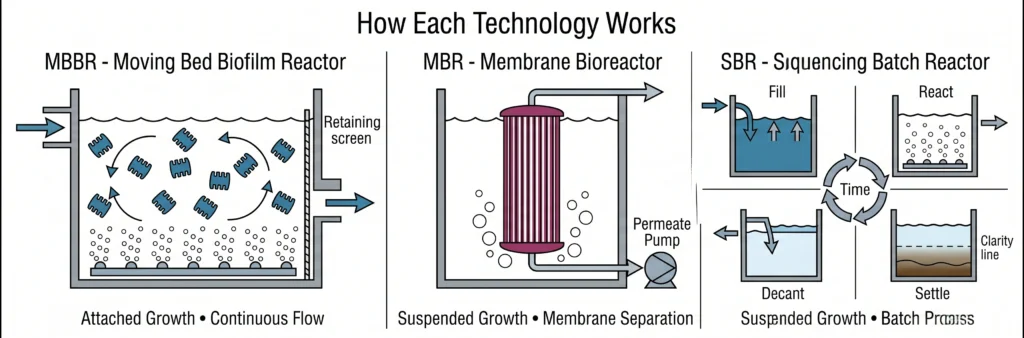
MBBR (Moving Bed Biofilm Reactor) — Attached Growth in Continuous Flow
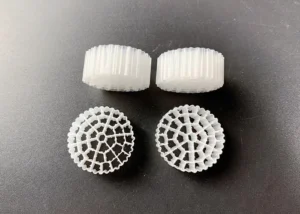
MBBR is an attached-growth system where microorganisms grow as biofilm on thousands of small, free-floating plastic carriers suspended in the aeration tank. The carriers — typically made from virgin HDPE with densities near 0.95 g/cm³ — are fluidized by aeration, ensuring uniform contact between biomass and wastewater. A retention screen at the outlet prevents carrier loss while allowing treated water to pass through to a downstream clarifier or filtration step.
Because the biomass is attached to carriers rather than suspended in mixed liquor, MBBR systems can maintain much higher effective biomass concentrations than conventional activated sludge — typically 3,000–5,000 mg/L in terms of biofilm mass — without the settling limitations that constrain suspended-growth systems. This decoupling of biomass retention from hydraulic retention time is the key engineering advantage.
MBR (Membrane Bioreactor) — Suspended Growth with Membrane Separation
MBR combines conventional activated sludge biological treatment with micro- or ultrafiltration membranes (typical pore size 0.02–0.4 µm) that physically separate solids from treated water. The membranes replace the secondary clarifier entirely, operating either submerged in the biological tank (the most common configuration for municipal applications) or as a sidestream loop.
MBR systems operate at much higher MLSS concentrations than conventional systems — typically 8,000–15,000 mg/L versus 2,000–4,000 mg/L. This high biomass concentration enables a small footprint but introduces the operational challenge of membrane fouling, which requires regular chemical cleaning and eventual membrane replacement every 5–8 years.
SBR (Sequencing Batch Reactor) — Time-Based Suspended Growth
SBR is a suspended-growth activated sludge system that uses time rather than space to separate treatment stages. All biological treatment steps — filling, aeration (react), settling, and decanting — occur sequentially in a single tank on a timed cycle, typically 4–6 hours per full cycle for municipal applications.
SBR’s advantage is the flexibility of batch processing: cycle times and aeration sequences can be adjusted for different treatment objectives — carbon removal, nitrification, denitrification, or biological phosphorus removal — within the same tank. The trade-off is that batch operation requires flow equalization for continuous influent streams and more sophisticated control logic than continuous-flow systems.
Side-by-Side Comparison Across Seven Criteria
The following table summarizes the typical performance range for each technology across the criteria that matter most in technology selection.
| Criterion | MBBRAttached | MBRMembrane | SBRBatch |
|---|---|---|---|
| Effluent BOD | <10–20 mg/L | <2–5 mg/L | <5–15 mg/L |
| Footprint | Compact | Very Compact | Moderate |
| CAPEX | Medium | High | Low/Med |
| OPEX | Low to Medium | High | Medium |
| Shock Load | Excellent | Moderate | Good |
* Green = Best in category | Yellow = Moderate | Red = Most challenging
Footprint
MBBR offers a footprint advantage over conventional activated sludge without the high capital cost of membrane systems. By decoupling biomass retention from clarifier performance, MBBR can achieve the same treatment capacity in roughly 60–80% of the tank volume required by a conventional system. Retrofits are particularly efficient: existing activated sludge tanks can typically be converted to MBBR operation with minimal civil work.
MBR provides the smallest footprint, typically requiring 30–50% of conventional tank volume, because membranes eliminate the need for secondary clarification and tertiary filtration. This makes MBR the default choice when land costs are extremely high, such as in urban areas or industrial facilities with severe space constraints.
SBR provides moderate footprint savings because the batch cycle requires idle time during settling and decanting, reducing effective treatment volume utilization. A single SBR tank typically operates at 50–60% volumetric utilization over a full cycle.
Effluent Quality
MBR produces the highest effluent quality. Membrane filtration removes essentially all suspended solids (TSS <1 mg/L) and provides significant pathogen removal, making the effluent suitable for non-potable reuse without additional tertiary treatment.
MBBR and SBR both produce effluent suitable for standard discharge permits (BOD <10–20 mg/L, TSS <10–30 mg/L), but neither can match MBR quality for reuse applications without additional polishing steps. Between the two, SBR tends to achieve slightly lower effluent solids because the quiescent settling phase produces clearer supernatant than the continuous overflow from an MBBR clarifier.
Energy Consumption
MBR is the most energy-intensive, consuming 0.40–0.70 kWh/m³, due to the combined demands of biological aeration and membrane scouring. Membrane scouring alone accounts for 25–35% of total energy use. The high MLSS concentration also reduces oxygen transfer efficiency, increasing the aeration energy required per unit of BOD removed.
SBR energy consumption falls in the middle range at 0.25–0.45 kWh/m³. The batch aeration cycle allows optimization of aeration intensity for each phase, but the inherent inefficiency of intermittent operation partially offsets this advantage.
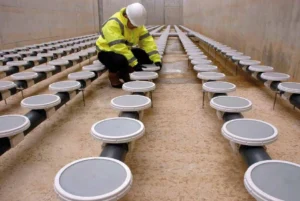
MBBR achieves the lowest energy consumption at 0.20–0.35 kWh/m³. The attached-growth system maintains high biomass without requiring return activated sludge pumping, and the biofilm’s natural oxygen gradient enables simultaneous nitrification-denitrification that reduces total aeration demand. Selecting appropriately designed fine bubble diffusers — matched to the tank geometry and carrier fluidization requirements — is critical to achieving the lower end of this range.
Sludge Production
MBBR generates less sludge than SBR because biofilm systems have longer sludge retention times (SRT typically 15–30 days), which promotes endogenous respiration and reduces net biomass yield. Typical sludge production is 0.3–0.5 kg TSS/kg BOD removed.
SBR produces more sludge at 0.5–0.7 kg TSS/kg BOD, comparable to conventional activated sludge, because the batch settling and decanting cycle makes it difficult to maintain the extended SRT that would minimize yield.
MBR generates the least sludge — 0.2–0.4 kg TSS/kg BOD — because the membrane retains all biomass, enabling SRT up to 60 days. However, accumulated inorganic solids and non-biodegradable fractions eventually require disposal, and the sludge is typically harder to dewater.
Capital and Operating Costs
SBR generally has the lowest capital cost because it uses a single tank instead of the multiple tanks and clarifiers required by continuous-flow systems. The trade-off is higher automation and control system costs relative to simple continuous-flow designs.
MBR has the highest capital cost, driven by the membrane modules themselves (typically 30–40% of total equipment cost) and the additional instrumentation and cleaning systems required. Operating costs are also highest, primarily from membrane scouring aeration energy and periodic chemical cleaning. Over a 20-year lifecycle, membrane replacement every 5–8 years adds significant recurring cost.
MBBR falls in the middle for both CAPEX and OPEX. The media adds material cost, but the absence of return sludge pumping, reduced tank volume, and lower aeration energy requirements keep operating costs below both SBR and MBR in most installations.
Application Scenarios: Matching Technology to Project Requirements
Choose MBBR When
Retrofitting an existing plant ——MBBR is the most practical option for increasing treatment capacity within existing tank volumes, requiring minimal structural modification.
Influent has high variability —— The attached-growth biomass is substantially more resilient to shock loads than suspended-growth systems.
Operator resources are limited —— MBBR is the simplest technology to operate, with no return sludge control, no membrane cleaning protocols, and no batch cycle programming.
Moderate effluent quality is acceptable —— For discharge permits requiring BOD <20 mg/L and TSS <30 mg/L, MBBR delivers reliably without the cost of membrane treatment.
Choose MBR When
Water reuse is the objective —— If the project requires effluent suitable for irrigation, cooling, or process reuse, MBR is the proven solution.
Land is prohibitively expensive —— In dense urban areas or constrained industrial sites, the footprint savings can justify the higher capital cost.
Nutrient limits are extremely stringent —— MBR can achieve total nitrogen <3 mg/L and total phosphorus <0.1 mg/L with chemical addition.
Choose SBR When
Capital budget is the primary constraint —— For smaller plants (typically under 5,000 m³/day), SBR offers the lowest initial investment.
Treatment objectives may change —— The flexibility to reprogram cycle times for different treatment targets is valuable when future requirements are uncertain.
Flow patterns are intermittent —— Batch operation naturally accommodates diurnal flow variations without requiring separate equalization.
Making the Decision: A Framework for Technology Selection
The choice between MBBR, MBR, and SBR comes down to how your project prioritizes four variables: effluent quality target, site constraints, capital availability, and operational capability.
Start by establishing non-negotiable requirements. If the discharge permit requires TSS <5 mg/L or the project includes water reuse, MBR is the only viable option. If the budget is fixed and below the threshold for membrane capital, the choice narrows to MBBR and SBR.
Next, assess existing infrastructure. For a retrofit of an existing activated sludge plant, MBBR offers the lowest disruption and fastest implementation. For a greenfield installation with ample space, SBR becomes more competitive.
Finally, evaluate operational resources. Plants with limited access to skilled operators or those in remote locations should favor MBBR for its simplicity and resilience. Facilities with dedicated process control staff can manage the higher complexity of SBR batch sequencing or MBR membrane maintenance.
No single technology dominates across all scenarios, which is precisely why the selection decision deserves the rigor of site-specific analysis rather than a one-size-fits-all recommendation.