
MBBR Retention Screens: Function, Types & Selection Guide
MBBR retention screens (also called media retention sieves or outlet screens) are installed at the outlet of an MBBR reactor. Their job is simple but critical: keep the MBBR media inside the tank while allowing treated water to pass through.
Without properly designed retention screens, media escapes into the next treatment stage — reducing biological capacity, damaging downstream equipment, and adding unnecessary replacement cost.
Why Retention Screens Matter
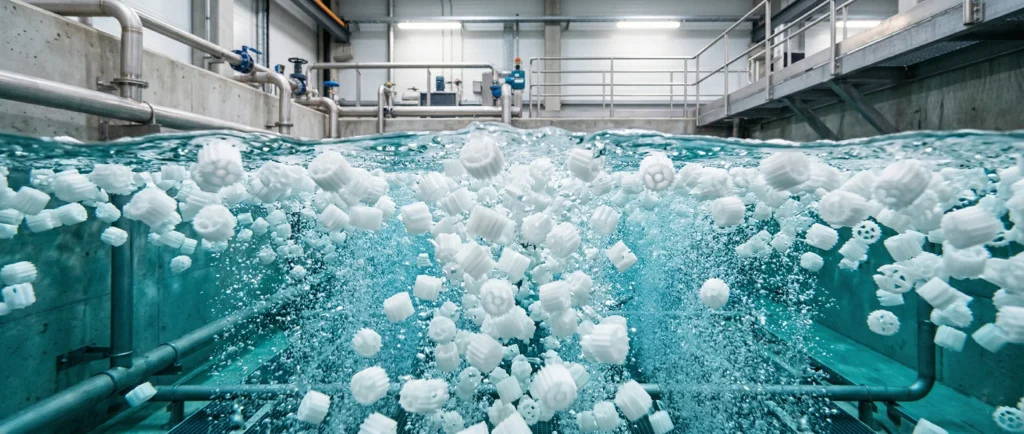
A MBBR reactor operates with 25–55% of its volume filled with free-floating media. The water leaving the reactor must pass through a screen that is:
- Small enough to block the media (slot width smaller than the media’s smallest dimension)
- Large enough to avoid excessive head loss and clogging
- Strong enough to withstand continuous hydraulic and mechanical stress
Common problem: Undersized or poorly designed screens clog within weeks, causing water level buildup and reducing treatment capacity. Oversized slots let media escape. Getting the slot width right is the most important design decision for retention screens.
Key Specifications
Motor Power
Stainless Steel 304 (standard)
Stainless Steel 316 (high-corrosion, marine, chemical)
Custom upon request
Slot Width
2–6 mm (select based on media type)
K1 / K3 / K5 → ~4–5 mm
Biochip → ~3–4 mm
Propeller
Wedge wire panel (most common)
Perforated plate
Cylindrical / drum type
Mounting
Flanged / bolted to outlet channel
Submerged or external
Custom fabrication available
MBBR Retention Screen Types
| Type | Description | Best For |
|---|---|---|
|
Wedge Wire Panel |
V-shaped wire wound on support rods. High open area, low clogging, self-cleaning effect. |
Most MBBR applications — standard choice. Recommended |
|
Perforated Plate |
Drilled holes in a flat plate. Simple, lower cost, but more prone to clogging. | Small-scale reactors, low-solid wastewater, budget-sensitive projects. |
|
Cylindrical / Drum |
Wedge wire or perforated material formed into a cylinder. High surface area in a compact footprint. | Retrofits where space is limited, high-flow systems. |
Sizing Guide
The right retention screen size depends on your reactor geometry and flow rate. Here are the key parameters to specify when ordering:
| Parameter | Guideline |
|---|---|
| Slot width | 60–80% of the media's smallest dimension. For K1 (11×7mm), slot width ≈ 4–5mm. |
| Open area ratio | Aim for >30% open area to minimize head loss across the screen. |
| Flow velocity through screen | Keep below 0.3 m/s to prevent media from being pressed against the screen. |
| Material thickness | 2–3 mm for most applications. Thicker for large reactors or abrasive wastewater. |
Need a custom size? We fabricate retention screens to your exact reactor dimensions. Send us your tank drawing and media type, and we’ll provide a quote.
Categories
Get the Perfect Media Match for Your System
Don’t guess your filling ratio. Simply share your project details—wastewater type, flow rate, and target effluent quality—and we’ll calculate the most efficient, cost-effective media solution for you.