A customer in Canada originally chose BioChip for his tilapia RAS — higher surface area meant better performance, he assumed. After we ran the numbers on his water temperature and feeding rate, we recommended K1 instead. His biofilter performed identically, and he saved about 30 percent on media cost. Species determines 80 percent of the choice.
If you have been shopping for MBBR media, you already know the problem: every supplier claims theirs is the best. K1 is the industry standard. BioChip has more surface area. K3 is built for big systems.
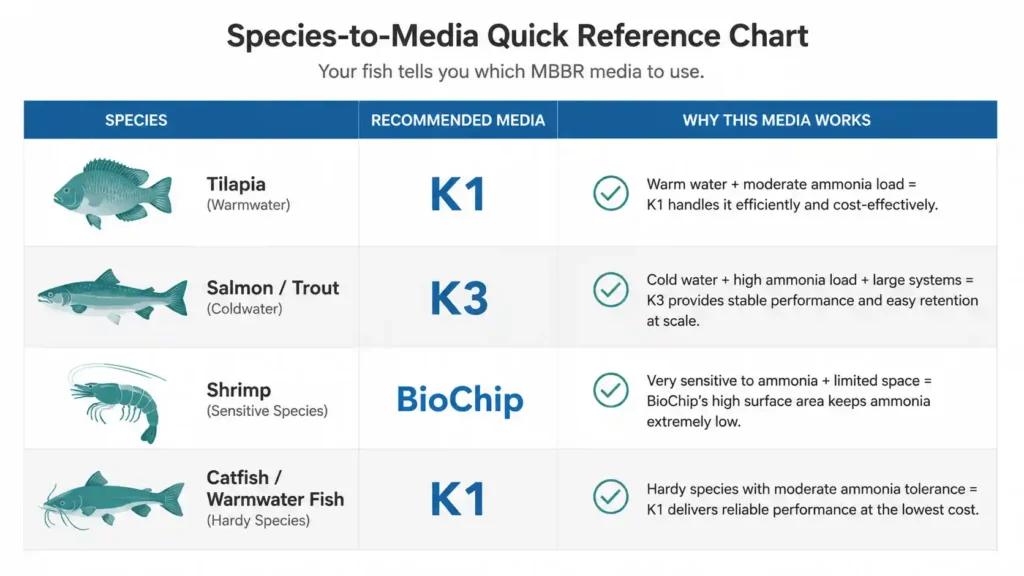
Here is the short answer: for tilapia, use K1. For shrimp, use BioChip. For salmon at commercial scale, use K3. Fill to 40 percent. Buy virgin HDPE only. That covers most RAS systems.
Quick Media Overview: K1, K3, K5, and BioChip
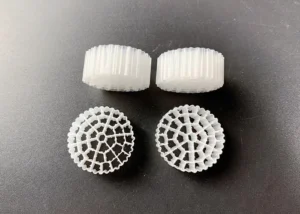
Four MBBR media types dominate the RAS market. Here is what each looks like on paper and what that means in practice.
| Media | Dimensions | Effective Surface Area | Bulk Density | Best For |
|---|---|---|---|---|
| K1 | 7 x 10 mm | 800+ m²/m³ | ~135 kg/m³ | General RAS, warmwater species |
| K3 | 25 x 10 mm | 500–600 m²/m³ | ~95 kg/m³ | Large systems, coldwater, high ammonia |
| K5 | 25 x 12 mm | ~500 m²/m³ | ~90 kg/m³ | Niche applications |
| BioChip | 15 x 15 mm | 1,200+ m²/m³ | ~110 kg/m³ | Compact systems, sensitive species |
A few things worth noting. Effective surface area is what matters — the protected interior channels where biofilm actually grows. Some suppliers quote total area that includes the exterior, which overstates real performance. Bulk density also varies by manufacturer. The numbers above are typical for virgin HDPE media from reputable suppliers. For detailed specifications across product types, check the MBBR bio media specifications and dimensions per product type.
Which Media for Which Species?
This section answers the question you actually have. Here is what I tell my customers based on what they grow.
Tilapia — K1
Tilapia RAS runs at 26–30°C. Warm water means fast nitrification — your bacteria work efficiently per square meter of surface area. At typical stocking densities of 40–80 kg/m³, the ammonia load is moderate. K1’s 800+ m²/m³ effective surface area handles it comfortably.
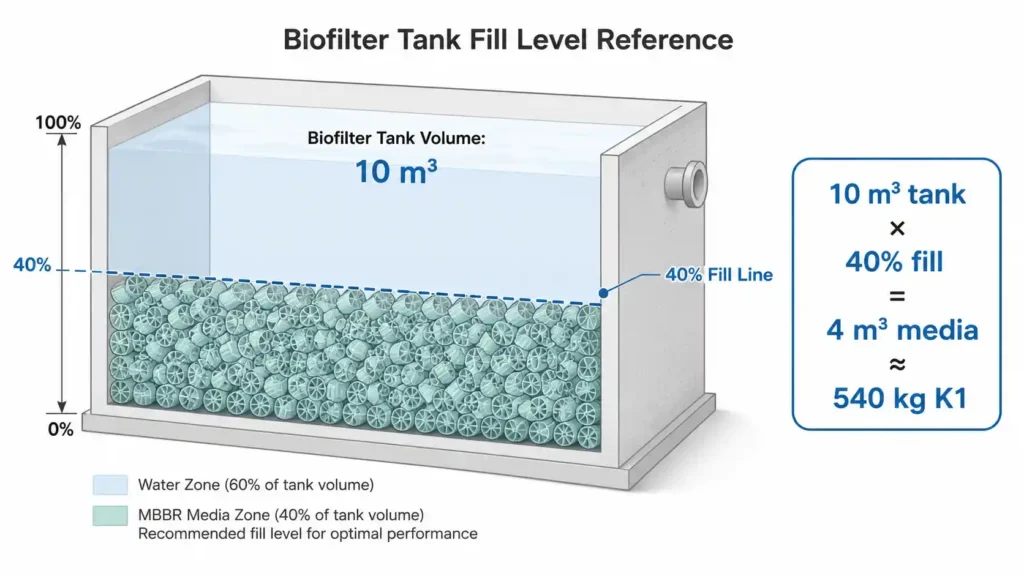
Most tilapia farmers I work with start at 40 percent fill and never need to adjust. A 10 m³ biofilter tank needs about 4 m³ of media — roughly 540 kg of K1. That fills the reactor, keeps ammonia under control, and costs less than premium alternatives that would not perform noticeably better in warm water.
If you are running a small to medium tilapia system, K1 is your answer. Manufactured from 100 percent virgin HDPE, it is the most cost-effective choice for this application.
Salmon and Trout — K3
Salmon RAS is a different challenge. Cold water at 10–16°C slows nitrification significantly. At the same time, salmon eat a high-protein diet that produces more ammonia per kilogram of feed than warmwater species.
K3’s larger diameter (25 mm) gives it an advantage here. In big biofilter tanks — common in commercial salmon farms — K3 fluidizes reliably with less aeration than denser media. It is also easier to contain with retention screens at scale, which matters when your biofilter holds 20 m³ of media or more.
For small salmon systems under 5 m³, K1 packed at a higher density can work fine. But if you are running commercial-scale salmon RAS, K3 is the right fit. It is manufactured from the same virgin HDPE material as K1.
Shrimp — BioChip
Shrimp are physiologically different from fish. Penaeus vannamei — the most widely farmed species — is highly sensitive to ammonia. Standard aquaculture references note that un-ionized ammonia above 0.02 ppm can cause gill damage and reduce growth. That is roughly ten times more sensitive than tilapia.
The ammonia load itself is modest — shrimp RAS runs at 3–10 kg/m³ stocking density. But the margin for error is tiny. BioChip’s advantage is not speed, it is buffer capacity. More effective surface area per cubic meter means more nitrification capacity in a smaller footprint. If a feeding spike pushes ammonia up, BioChip absorbs it without a dangerous spike.
For compact systems or farmers who want maximum water quality stability, BioChip is worth the premium. K1 can work in shrimp systems with oversized biofilters and conservative feeding, but BioChip gives you room to breathe.
Catfish and Other Warmwater Species — K1
Catfish, pangasius, and similar warmwater species follow the same logic as tilapia. Moderate ammonia loading, warm temperatures, forgiving water quality tolerances. K1 at 40 percent fill covers it well.
For polyculture systems raising multiple species, start with K1 as the default. It handles a broad range of conditions without overcomplicating the design. If you later find ammonia creeping up at peak feeding, increase fill to 50 percent after verifying aeration capacity, rather than switching media types.
How Much Media Do You Actually Need?
Here is the simple version. No calculations beyond basic multiplication.
The rule: Fill your biofilter tank to 40 percent of its empty volume. That is the starting point for most RAS systems.
Example: Your biofilter tank holds 10 m³ of water. At 40 percent fill, you need 4 m³ of media. For K1 at roughly 135 kg per m³, that comes to about 540 kg.
| Tank Volume | 40% Fill | K1 Weight (approx.) | K3 Weight (approx.) |
|---|---|---|---|
| 5 m³ | 2 m³ | ~270 kg | ~190 kg |
| 10 m³ | 4 m³ | ~540 kg | ~380 kg |
| 50 m³ | 20 m³ | ~2,700 kg | ~1,900 kg |
| 100 m³ | 40 m³ | ~5,400 kg | ~3,800 kg |
A few practical notes. Forty percent is a starting point, not a fixed rule. Some systems run at 30 percent (hatcheries, low-density) or 50 percent (high-density with good aeration). Do not fill above 50 percent unless you have verified your aeration can keep the media fluidized. At 60 percent fill, most systems struggle to keep media moving, which creates dead zones and reduces effective treatment volume. Also, bulk density varies by supplier, so use the number your media provider gives you. For a deeper look at how to verify MBBR media specifications before purchasing, including density testing and quality documentation, the full guide covers what to ask for.
What to Avoid When Buying MBBR Media for RAS
Recycled Plastic
This is the biggest trap. Some suppliers sell media made from recycled HDPE at a 15 to 20 percent discount. It looks identical to virgin material. But research from the Fraunhofer Institute (2023) found that recycled HDPE contains non-intentionally added substances (NIAS) at levels that are toxicologically concerning. The European Food Safety Authority’s migration limit for recycled HDPE in food contact is 0.06 μg/L — effectively prohibiting its use.
Your fish swim in this water 24/7. Vorexwater uses 100 percent virgin HDPE across all media types, with material certificates tracing each batch to a known virgin resin producer. Our guide on virgin vs recycled HDPE verification methods explains what documentation to request from any supplier.
Inflated Surface Area Claims
When a supplier quotes “1,200 m²/m³”, ask whether that is effective (protected) surface area or total geometric area. The difference can be 30 to 50 percent. For RAS biofiltration, effective surface area is what matters — the interior channels where biofilm grows protected from shear. If a supplier cannot explain the difference, consider it a red flag.
Retention Screen Mismatch
Media that fits your biofilter but passes through your retention screen is useless. The general guideline: screen openings should not exceed 70 percent of the smallest media dimension for cylindrical carriers, and 50 to 60 percent for flat media like BioChip. K1 is 7 mm in its smallest dimension; if your screen gap exceeds about 5 mm, you will lose media continuously. For a full treatment of screen types, sizing calculations, and installation considerations, see the MBBR retention screen selection and media containment guide.
Quick Startup Tip: Seed Your Biofilter
The fastest way to start your biofilter is to seed it with mature media from an existing RAS system. Even a bucket of colonized media from a nearby farm can cut your startup time from 6–8 weeks to 2–3 weeks. The established biofilm gives your nitrifying bacteria a massive head start.
If you cannot get seeded media, start with a low ammonia source (fish or chemical) from day one. Expect a nitrite spike around week 2–4 — that is normal. It means ammonia-oxidizing bacteria are working, and nitrite-oxidizers are catching up. Monitor ammonia and nitrite every 2–3 days during the first 6 weeks. Full nitrification typically stabilizes between week 6 and week 8.
Do not rush the process. A biofilter that matures slowly is more stable long-term than one you try to force with heavy feeding.
Bottom Line: Species Decides, Fill to 40%, Buy Virgin Only
Species tells us most of what we need to know, but the final recommendation depends on your specific operating conditions. To recommend the correct media type and quantity, we normally need only four parameters:
- Species you are growing (or plan to grow)
- Daily feeding rate (kilograms of feed per day)
- Biofilter tank volume (cubic meters)
- Operating water temperature (°C)
Send these four numbers to our team and we will respond with a media type recommendation, estimated quantity in both volume (m³) and weight (kg), and retention screen sizing guidance tailored to your system.