In Peterborough, Ontario, an 18 MGD MBBR plant lost its media so catastrophically that operators replaced the entire biological treatment system — the failure documented by Entex Technologies is a textbook case of rigid media degradation. Rigid plastic carriers broke down over years of operation, fragments passed through the retention screens, and there was no economical way to recover them. On the coast of Parana, Brazil, a 2024 study in Ocean and Coastal Research found 749 plastic biomedia items washed up across 11 beaches, traced to a local MBBR plant.
Media washout is an operational crisis — replacement media is expensive, and losing biofilm surface area drops treatment performance. It is also an environmental liability you do not want to explain to regulators. The good news: almost every washout incident I have investigated was preventable. The root cause nearly always traces back to one overlooked component — the retention screen.
What Causes MBBR Media Washout in Wastewater Treatment Systems?
Four failure modes cause the vast majority of media loss. The first is where most trouble starts.
Screen Aperture Mismatch
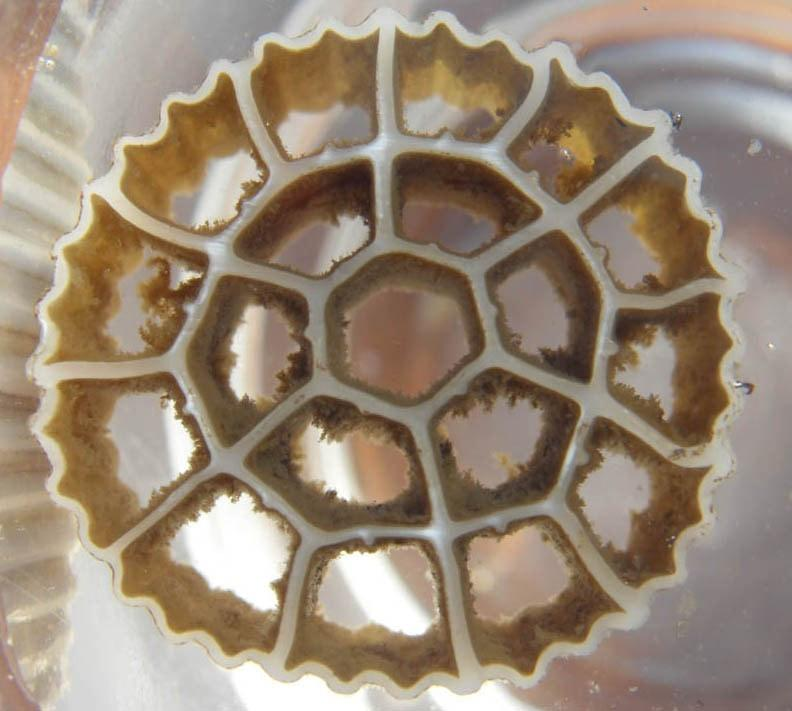
This is the most common cause and the most preventable. If the screen opening is larger than the smallest dimension of your media, media escapes. Simple? Yes. But here is what catches most operators: media dimensions change over time.
The rule I use: slot opening should not exceed 70% of the smallest media dimension for cylindrical carriers — SSI Aeration applies the same guideline in their fixed-film system designs. For flat or chip-type media, the ratio needs to be tighter — 50-60% — because flat media can wedge in slot openings. For K1 media (9.1 x 7.2 mm), that means a maximum 5 mm aperture. For K3 (25 x 10 mm), 7 mm. For Biochip (~15 x 15 mm with 2.2 mm thickness), no more than 1.5 mm — flat media needs the more conservative ratio.
Virgin HDPE carriers last 10-15 years under normal operation. Recycled plastic carriers start fragmenting at 3-7 years. A screen sized for fresh media may let aged, worn media pass right through. The Peterborough failure is textbook — media broke down over time, fragments escaped through screens sized for virgin dimensions, and the system was unrecoverable. If you are evaluating media options, verify your MBBR media types and specification verification before committing to screen dimensions.
Hydraulic Surge
During peak flow events, the approach velocity to your retention screen can spike above 30-35 m/hr — the upper limit established by WEFTEC 2011 research by McQuarrie and Boltz. When that happens, headloss across the screen climbs, the liquid level rises behind it, and media flows over the top.
This is especially dangerous in systems with intermittent aeration and diffuser selection for MBBR systems. When air cuts off, the mixing that keeps media suspended stops, and media settles near the outlet. When air comes back on, the surge pushes that settled media directly toward the screen. Verify your screen freeboard and approach velocity at peak instantaneous flow, not just average daily flow.
Screen Clogging
Hair, textile fibers, and biofilm sloughing are the culprits. The failure cascade is predictable: debris accumulates on the screen, effective open area drops, backpressure rises above 0.25 bar, and operators are forced to cut flow by 45% to protect the system. When a peak event hits, the restricted screen cannot pass the flow — so media overflows. A textile plant in India — 20,000 m³/day — was cleaning retention screens 24 times per year because fibrous material kept jamming them, a case study documented by Juntai Environmental.
The solution for fibrous influent is upstream pre-screening with 1 mm rotating drum filters, combined with self-cleaning retention screens.
Media Degradation
Media does not last forever. I have walked into plants where the carriers look like gravel — chipped, cracked, surface-roughened from years of abrasion. The indicators are hard to miss once you know what to look for: unexplained TSS spikes in the secondary clarifier (plastic fines), ammonia oxidation rates dropping below expected benchmarks, and visible media volume loss in the reactor.
The material matters enormously. Virgin HDPE handles 10-15 years of continuous fluidization. Recycled plastic carriers start embrittling within 3-7 years. If you are using recycled media to save upfront cost, plan to replace it as dimensional changes will eventually allow fragments to pass through even properly sized screens.
Which Retention Screen Type Is Right for Your MBBR System?
Three main screen technologies for MBBR retention are not interchangeable. Here is how they compare.
| Screen Type | Open Area | Clogging Resistance | Cost | Best Application |
|---|---|---|---|---|
| Wedge Wire | 30-50% | Excellent (self-cleaning via Coanda effect) | High | High-flow, variable loading, fibrous influent |
| Perforated Plate | 15-30% | Low (prone to clogging with hair and fibers) | Low | Small systems, stable flow, clean influent |
| Drum Screen | 20-35% | Very good (rotating self-cleaning) | Highest | Large plants >5,000 m3/day, high solids |
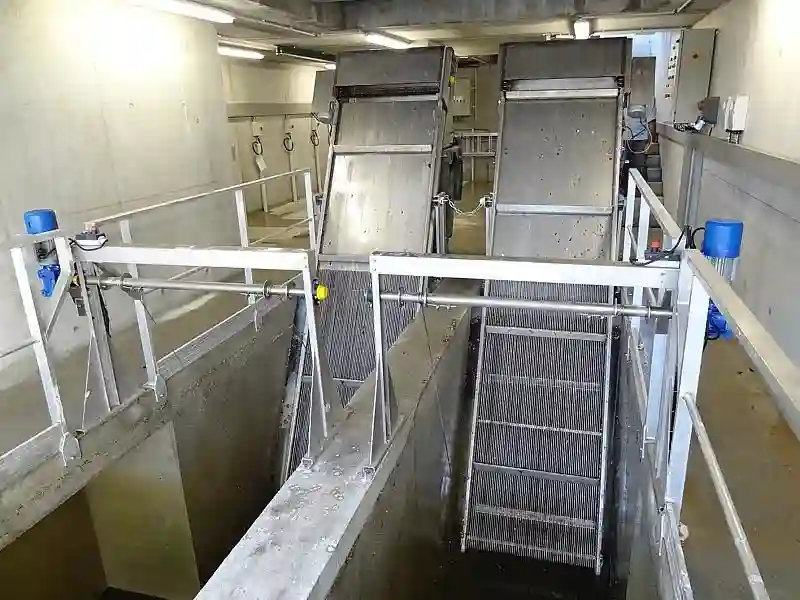
Wedge wire is my default recommendation for most applications. The V-shaped slot profile is narrow at the surface and wider internally — particles that enter the opening pass through rather than wedging in place. The Coanda effect (wire tilted approximately 5 degrees downstream) creates a shearing action that keeps the screen clear. Slot tolerance is +/-0.05 mm, which matters when you are trying to retain 7.2 mm media with a 5 mm opening. The downside is cost, but avoided downtime and media replacement pay for the difference.
Perforated plate is simple and cheap. Open area is typically 15-30%, roughly half of wedge wire, meaning higher headloss for the same flow. Without any self-cleaning mechanism, it clogs readily with fibrous material. I only recommend it for small systems with clean municipal influent and stable flow, where operators can inspect screens visually each shift.
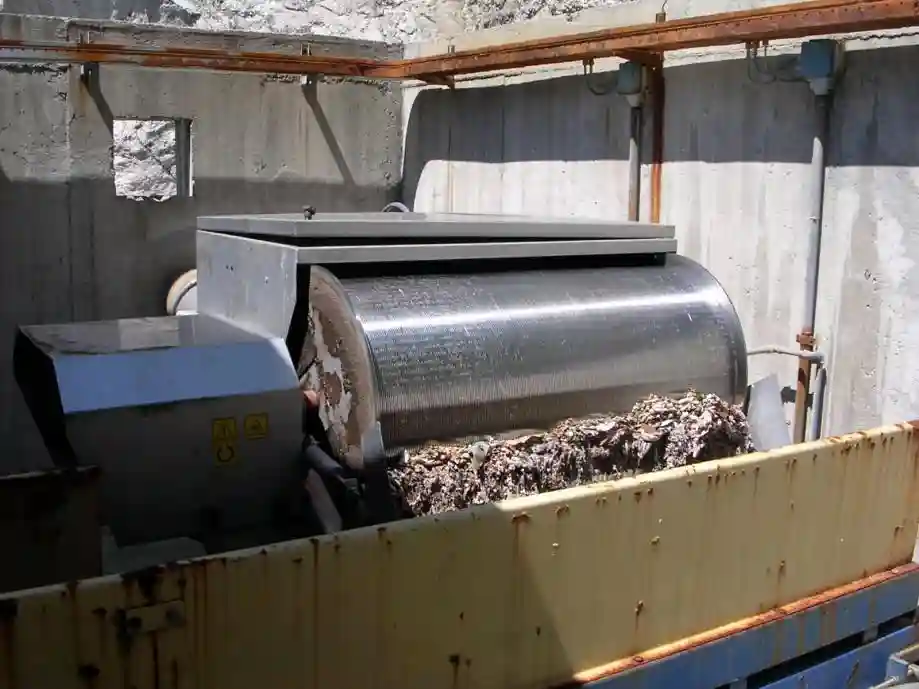
Drum screens are the right choice for large plants. The rotating mesh (1-3 mm openings) with external spray bars provides continuous self-cleaning. Capture efficiency at 1 mm is excellent in field installations. Moving parts — motors, bearings, brushes — need regular maintenance, but for plants treating over 5,000 m3/day with challenging influent, the tradeoff is worth it.
How to Calculate the Right Screen Size for MBBR Media Retention?
Getting the screen specification right comes down to three numbers.
Approach velocity: Keep it under 30-35 m/hr under all flow conditions, including recirculation. This is the WEFTEC 2011 guideline and I have found it holds up across dozens of installations. In rectangular tanks where approach velocity exceeds this limit, reduce the hydraulic loading rate or reconfigure the flow pattern. Circular tanks are less problematic because screens are placed equidistantly around the periphery.
Screen hydraulic loading rate (HLR): Design for 50-60 m3/m2/hr, covering both forward flow and internal recirculation. Going higher risks headloss spikes during peak events.
Slot opening: The 70% rule for cylindrical media — tighter for flat types. Here are the numbers for common media types:
- K1 (9 x 7 mm) → max 5 mm aperture
- K3 (25 x 10 mm) → max 7 mm aperture
- K5 (25 x 3.5 mm) → max 2 mm aperture
- Biochip (~15 x 15 x 2.2 mm) → max 1.5 mm aperture
The media dimensions you use for these calculations must be verified against your actual product. Different manufacturers produce K1 and K3 equivalents with slightly different geometries, and those millimeters matter at the screen gap. Check your MBBR media types and specification verification against the manufacturer data sheet before ordering.
Also design for a maximum pressure drop of 50-150 mm at peak hydraulic flow. Once you see backpressure consistently above 0.15 bar during normal operation, it is time to inspect your screens.
How Can You Prevent MBBR Media Loss Through System Design?
Prevention is about building redundancy and monitoring into the system from day one.
Pre-screen aggressively. If your influent carries hair, textile fibers, or debris, install 1 mm rotating drum filters upstream of the MBBR zone. That textile plant in India reduced screen cleaning from 24 events per year to 2 after adding this step. Carrier recovery went above 99%. This is one area where spending upfront on screening saves exponentially on downstream recovery costs.
Install redundant level sensors. Single-point level detection is a single point of failure. Redundant sensors with high-level alarms give operators time to respond before media overflows. I have seen plants avoid a washout event by catching a rising water level 30 seconds before the media reached the overflow weir.
Use self-cleaning mechanisms. Wedge wire screens with air-lift backwash integrated at the base can clear accumulated debris without taking the screen offline. For wedge wire, verify that the slot orientation and cross-flow velocity maintain the self-cleaning effect — it does not work if the flow is too low. The fine bubble vs coarse bubble diffuser comparison covers how aeration configuration affects the hydraulic environment around retention screens.
Monitor the right KPIs. The KPI thresholds below are adapted from published MBBR operational guidance from Juntai Environmental and field-validated across multiple installations.
- Pressure drop across screen: Keep below 0.15 bar. At 0.25 bar, intervene immediately.
- Carrier density: 300-400 kg/m3. Above 450 kg/m3, remove 10% of the media.
- Biofilm thickness: 100-300 um. Above 400 um, increase shear via aeration adjustments.
Inspect media annually. Pull a sample of carriers from the reactor. Look for cracking, chipping, surface roughness, and color change. Measure their dimensions. If the smallest dimension has decreased by more than 10%, your screen apertures may soon be too large. Schedule a screen replacement before the next peak flow season.
MBBR Media Washout Prevention Checklist
Here is the short version for your next design review or plant walkthrough.
- Measure your media smallest dimension and verify screen apertures do not exceed 70% of that value for cylindrical media (50-60% for flat types).
- Confirm approach velocity stays below 30-35 m/hr at peak flow — including recirculation.
- Install upstream pre-screening (1 mm or finer) for influents with hair, fibers, or high solids.
- Monitor pressure drop across screens weekly. Anything above 0.15 bar needs investigation.
- Inspect media condition annually — look for fragmentation, dimension change, and surface wear.
- Never add loose MBBR media to SBR tanks. The decanter will wash it out.
A properly designed retention screen is invisible when it works and unforgettable when it does not. Get the screen right, and media washout becomes something you read about rather than something you explain to your plant manager.