Can You Use Fine Bubble Diffusers in Anoxic Zones?
It’s a question I hear regularly from engineers designing or retrofitting biological nutrient removal (BNR) plants: “Can I use fine bubble diffusers in a zone that cycles between anoxic and aerobic conditions? Won’t they clog when the air shuts off?”
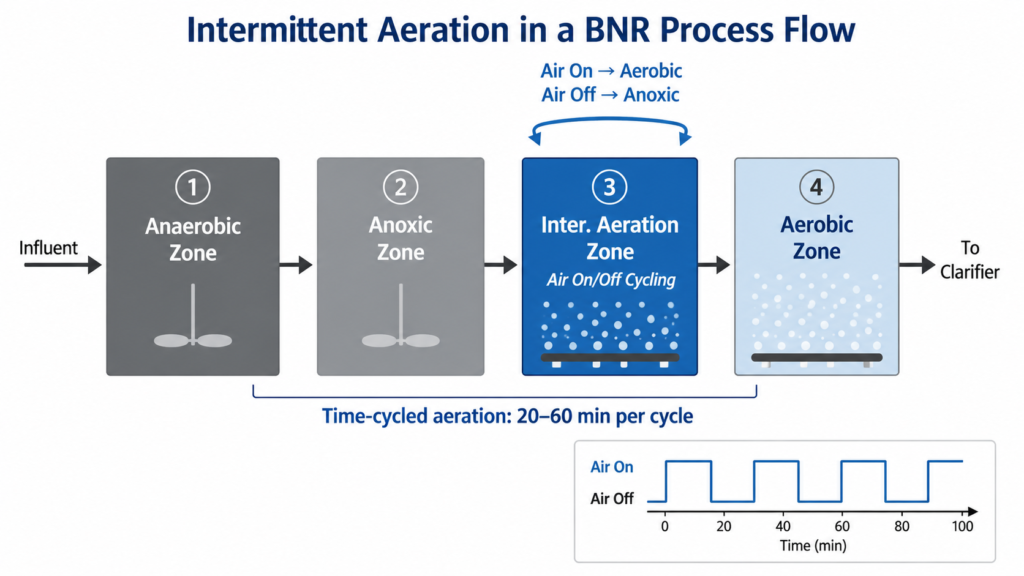
It’s a fair question — and the answer has changed over the past two decades. The same aeration system design principles that make fine bubble diffusers the standard choice for continuous aeration now apply to intermittent operation as well.
Why Does Intermittent Aeration Raise Concerns for Fine Bubble Diffusers?
The concern about using fine bubble diffusers in intermittent aeration applications has a specific, well-founded origin: it comes from the era of ceramic and stone porous diffusers.
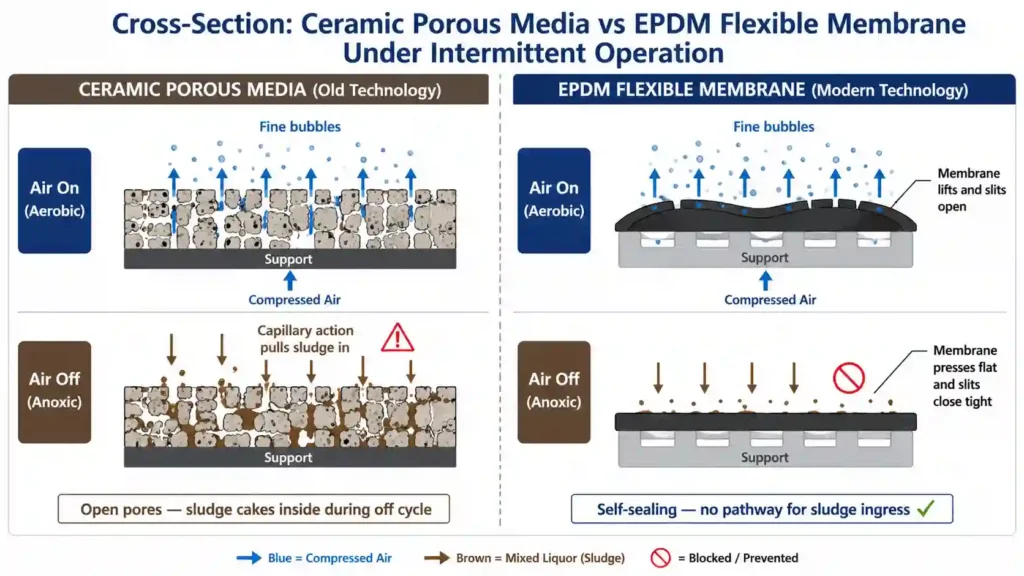
Here’s what happened when those old diffusers were used in air-on/air-off service: during the aeration cycle, air was forced through the porous ceramic, creating fine bubbles. When the air shut off, the open-pore ceramic structure acted like a sponge. The external water pressure — typically 3 to 6 meters of head — drove mixed liquor into the pores through capillary action. Inside those pores, the sludge-laden water sat stagnant during the off cycle. By the time the air came back on, the trapped solids had dried and caked inside the pores. Over repeated cycles, the blocked pores caused a permanent drop in oxygen transfer efficiency.
This was not a theoretical risk. It was a well-documented operational reality documented in EPA design manuals for fine pore aeration systems. The industry response was sensible and became standard specification: “Don’t use fine bubble diffusers in intermittent aeration. Use coarse bubble instead.” That rule got written into design guidelines where many engineers still encounter it today.
How Do Modern EPDM Membranes Solve the Clogging Problem?
The equipment landscape shifted when manufacturers introduced flexible membrane diffusers — first EPDM (ethylene propylene diene monomer) rubber, then silicone and polyurethane alternatives. These membranes operate on a fundamentally different principle than rigid porous media.
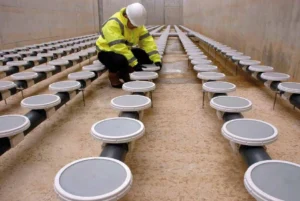
Instead of a network of fixed pores, a flexible membrane diffuser works by stretching a thin elastomeric sheet over a support structure. Precision slits or perforations are cut through the membrane. When compressed air is supplied, the membrane lifts slightly away from the support, and the slits open to release fine bubbles. When the air supply stops, the external water pressure presses the membrane flat against the support — and those same slits close tight.
This self-sealing mechanism — essentially a built-in check valve — is what makes modern fine bubble diffusers suitable for intermittent aeration. With the perforations closed during the off cycle, there’s no open pathway for mixed liquor to enter the diffuser or the air distribution piping. The sludge backflow problem that plagued ceramic diffusers simply doesn’t occur with modern fine bubble membrane diffusers.
What Are the Benefits of Using Fine Bubble Diffusers in Intermittent Aeration Zones?
If the clogging concern is resolved, the next question is obvious: what do you gain by using fine bubble diffusers in zones that cycle on and off, instead of coarse bubble?
The short answer: significantly better oxygen transfer efficiency during the aerobic portion of each cycle. This directly impacts your overall aeration energy costs.
Parameter
Coarse Bubble
Fine Bubble (EPDM Membrane)
Typical SOTE at 5m depth
4–8%
18–30%
Bubble diameter
≤50 mm
1–3 mm
Airflow required for same O2 transfer
Baseline
40–60% less
Blower energy during aerobic cycles
Baseline
Significantly lower
Mixing intensity
High
Moderate (mechanical mixers recommended for anoxic mixing)
Real-World Results: Lebanon, PA
The City of Lebanon, Pennsylvania provides a documented case. During their IFAS upgrade, they installed fine bubble diffusers in zones with intermittent aeration — zones that cycle between anoxic and aerobic operation — paired with mechanical mixers for mixing during off cycles. Treatment Plant Operator magazine covered the upgrade and reported an estimated 15% reduction in energy use from the intermittent aeration control strategy alone, with an additional 10% reduction from advanced aeration control in the main aerobic zones. The fine bubble diffusers operated reliably through thousands of on-off cycles without clogging.
When Should You Still Choose Coarse Bubble Diffusers?
I don’t want to give the impression that coarse bubble diffusers are obsolete for intermittent aeration. They’re not. The self-sealing membrane solves the backflow problem, but several application scenarios still favor coarse bubble:
Very deep tanks (>15 meters / 50 feet): At these depths, fine bubbles coalesce during their long rise path, diminishing the SOTE advantage. And if anything goes wrong at the bottom of a deep tank, the cost of draining and repair is so high that the reliability of coarse bubble becomes the deciding factor.
High FOG (fats, oils, grease) environments: Where FOG exceeds 30 mg/L, coarse bubble’s self-cleaning action and strong mixing prevent fouling that can blind fine bubble membranes.
High scaling potential: Wastewater with high hardness or iron content can precipitate scale on any submerged surface. Coarse bubble diffusers tolerate this buildup far better than fine bubble membranes.
Solids requiring intense mixing: In aerobic digesters or high-solids applications, the mixing energy from coarse bubble may be needed even if oxygen demand could be met with fine bubble.
Bottom line: The old rule — “don’t use fine bubble in intermittent aeration” — was correct for ceramic diffusers. Modern EPDM and silicone membrane diffusers have eliminated the sludge backflow risk. For a complete breakdown of where each technology fits, see our fine bubble vs coarse bubble comparison guide.
How to Choose the Right Diffuser for Intermittent Aeration Applications
If you’re designing a new system or retrofitting an existing one for intermittent aeration, here’s my recommendation:
Evaluate the specific conditions and select accordingly — don’t default to coarse bubble just because of the old rule. In most municipal BNR and SBR applications with standard tank depths (4–8 meters), fine bubble EPDM membrane diffusers will deliver significantly better energy performance with reliable operation through thousands of on-off cycles. You’ll still need mechanical mixers or an alternative mixing method for the anoxic periods — the diffusers handle aeration, but they’re not designed for solids suspension when the air is off.
For a broader comparison of fine bubble and coarse bubble diffuser selection across all applications — including detailed SOTE benchmarks and design parameters — refer to our fine bubble vs coarse bubble diffuser guide. And if you’re planning an energy optimization project, our guide to reducing aeration energy costs covers the full three-tier approach.
Whether you’re designing a new plant or upgrading an existing one, our team can help you select the right bio media, aeration equipment, and clarification solutions.