Aeration accounts for 50–75% of a treatment plant’s total energy consumption, according to the U.S. Environmental Protection Agency’s design manual on fine pore aeration systems. The choice between fine bubble and coarse bubble diffusers may be the single most consequential equipment decision a plant makes. But the answer is rarely “fine bubble is always better” — it depends on whether your plant needs oxygen transfer efficiency, solids suspension, or maintenance simplicity most.
This article compares both technologies on the parameters that matter in practice — SOTE, mixing, maintenance demand, and total cost of ownership — and provides a decision framework for matching the diffuser to the specific application.
How Do Bubble Size and Mass Transfer Differ Between Fine and Coarse Diffusers?
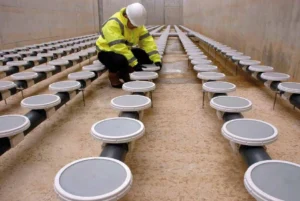
Fine bubble diffusers produce bubbles in the 1–3 mm range by forcing air through a porous membrane. The small diameter creates two advantages: more surface area per volume of air, and a slower rise velocity. Both factors increase gas-liquid contact time, directly improving oxygen dissolution. A typical fine bubble disc diffuser operating at 4–6 meters depth delivers a standard oxygen transfer efficiency (SOTE) of 15–40%, depending on diffuser density and airflow rate — consistent with the EPA’s published performance ranges for fine pore aeration.
Coarse bubble diffusers produce bubbles between 6 and 50 mm via perforated pipe or large-orifice headers. A single 10 mm bubble has roughly one-tenth the surface-area-to-volume ratio of a 1 mm bubble, and rises about three times faster. The net result is that coarse bubble diffusers typically achieve only 4–8% SOTE under comparable conditions, as documented in the same EPA reference on aeration system performance.
How Much Energy Can Fine Bubble Diffusers Save Compared to Coarse Bubble?
The efficiency advantage translates directly into energy savings. The U.S. Department of Energy reports fine bubble systems deliver approximately 6.5 lb O2/hp-hr, compared to 2.0 lb O2/hp-hr for coarse bubble — a more than threefold advantage in standard aeration efficiency (SAE).
For a mid-sized municipal plant with an aeration energy cost of $300,000–$500,000 per year, switching from coarse to fine bubble typically reduces electricity consumption by 30–50%. The Ridgewood, New Jersey wastewater treatment plant reported a 28% reduction in total plant power consumption after converting from coarse bubble to fine pore aeration, with annual savings of $22,400.
But energy savings are not the only variable. The table below summarizes the key differences compiled from the EPA’s aeration design manual and the DOE tip sheet.
| Parameter | Fine Bubble | Coarse Bubble |
|---|---|---|
| Bubble diameter | 1–3 mm | 6–50 mm |
| SOTE (at 4–6 m depth) | 15–40% | 4–8% |
| Standard aeration efficiency | 4.0–7.0 lb O2/hp-hr | 1.5–3.0 lb O2/hp-hr |
| Relative air requirement | Baseline (1×) | 2–3× for same O2 transfer |
| Mixing strength | Moderate | Strong (vertical pumping) |
| Fouling resistance (α factor) | Lower (α = 0.3–0.6) | Higher (α = 0.6–0.9) |
| Membrane/component replacement | Every 8–12 years | Minimal (no membrane) |
| Cleaning frequency | Every 2–5 years | Rarely required |
| Relative capital cost | Higher | Lower |
When Should You Choose Fine Bubble Diffusers?
Fine bubble diffusers are the default specification for most secondary biological treatment. In plants where oxygen transfer is the rate-limiting step and energy costs are significant, they deliver the best return on investment.
Secondary activated sludge and MBBR systems
Conventional ASP, SBR, and MBBR processes all require consistent high-rate oxygen transfer. Fine bubble diffusers deliver the highest SOTE and are the standard choice, provided the plant can support periodic maintenance.
Energy-sensitive facilities
For plants where electricity represents 15–25% of the operating budget, the 30–50% reduction in aeration power has a direct impact on the bottom line. Our earlier comprehensive aeration energy optimization guide covers the full methodology for calculating potential savings at your plant.
Nitrification and extended aeration
Processes with high oxygen uptake rates (OUR > 40 mg/L/h) benefit directly from higher SOTE. In these applications, the energy savings alone can justify the additional capital expenditure.
Concentration?
(Fine + Coarse)
(Fine + Coarse)
(Energy + Maintenance + Lifecycle)
The caveat, and it is an important one: fine bubble membranes require periodic cleaning. A diffuser that starts at 30% SOTE can drop below 15% after 3–5 years without maintenance. Plants that lack the staff or budget for periodic cleaning should factor this into their decision.
When Is Coarse Bubble Aeration the Better Choice?
Despite their lower oxygen transfer efficiency, coarse bubble diffusers remain the right choice — sometimes the only practical one — in applications where mixing, reliability, or solids handling take priority.
Equalization basins and grit chambers
These need mixing to keep solids in suspension, not high-rate oxygen transfer. A coarse bubble grid provides the necessary turnover at significantly lower capital cost, and the large orifices resist clogging from heavy solids loads.
Aerobic digesters
MLSS in an aerobic digester ranges from 10,000 to 25,000 mg/L — 5–10 times that of a conventional aeration basin. At these concentrations, fine bubble membranes foul rapidly. Coarse bubble diffusers handle the conditions with minimal degradation.
High-solids industrial wastewater
Food processing, pulp and paper, and brewery waste streams contain fibrous material that blinds fine bubble membranes. An operator at a brewery plant I worked with switched from fine to coarse bubble after repeatedly dewatering basins to replace fouled discs — the energy cost went up, but the downtime went to near zero.
Deep basins and limited-maintenance plants
In tanks deeper than 6 meters, coarse bubble’s lower head loss is an advantage. Smaller facilities without maintenance staff often prefer the “install and forget” reliability of coarse bubble, accepting higher energy cost for operational simplicity.
Can You Use Fine Bubble and Coarse Bubble Diffusers Together?
The best strategy at many plants is not one type or the other, but both. Combined systems use fine bubble diffusers for bulk oxygen transfer, supplemented by coarse bubble diffusers or mechanical mixers to maintain solids suspension when aeration rates are reduced — during low-load periods or in swing zones that alternate between aerobic and anoxic operation.
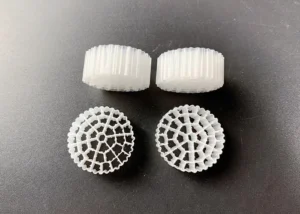
This is particularly relevant for MBBR system design, where fine bubble diffusers provide oxygen for biofilm activity while coarse bubble grids help ensure full media fluidization. Some designers prefer fine bubble tube diffusers in these applications for their more uniform air distribution across long, narrow basins.
I’ve seen several retrofit projects where a plant added a coarse bubble grid to an existing fine bubble system — not to replace it, but to supplement mixing where the fine grid alone could not keep solids suspended at reduced airflow. The hybrid solution preserved the energy benefit while resolving the mixing limitation.
How to Choose Between Fine Bubble and Coarse Bubble Diffusers?
When evaluating diffuser options for a new build or retrofit, the selection process comes down to four questions:
- What is the primary process requirement? Oxygen transfer → fine bubble. Solids suspension or mixing → coarse bubble.
- What are the wastewater characteristics? High solids or fibrous material favors coarse bubble or a hybrid approach.
- What is the maintenance capability of the plant? A fine bubble system without a maintenance plan will underperform within 3–5 years.
- What is the cost of energy at this location? At rates above $0.10/kWh, fine bubble payback typically drops below 3–4 years.
Illustrative annual aeration energy costs for a 10 MGD municipal plant operating at $0.08/kWh. Actual results vary depending on basin geometry, airflow requirements, and process conditions.
Which Diffuser Type Is Best for Your Wastewater Application?
The table below provides a quick reference for matching diffuser type to common wastewater treatment applications.
| Application | Recommended Type | Primary Consideration |
|---|---|---|
| Activated sludge (secondary treatment) | Fine bubble | Energy efficiency dominant |
| MBBR aeration | Fine bubble + mixing assist | Oxygen transfer + media fluidization |
| Nitrification / extended aeration | Fine bubble | High oxygen uptake rate |
| Aerobic digestion | Coarse bubble | High solids, fouling resistance |
| Equalization basin | Coarse bubble | Mixing, low capital cost |
| Grit chamber | Coarse bubble | Solids handling, durability |
| High-solids industrial wastewater | Coarse bubble | Fouling resistance |
| Large municipal plant (energy-sensitive) | Fine bubble | 30–50% energy savings potential |
| Deep basin (>6 m) | Coarse bubble | Head loss, mixing at depth |
| Limited maintenance resources | Coarse bubble | Operational simplicity |
The question is not which diffuser type is “better” — it is which type is better for your specific application. Fine bubble delivers superior energy performance when paired with a maintenance program. Coarse bubble provides durability and mixing where those matter most. A hybrid approach captures the advantages of both where neither alone is sufficient.