If your MBBR reactor keeps losing media — or you’re building one and want the outlet right the first time — the retention screen is the part that decides it. And buying one is mostly a material question: stainless steel grade first, then slot size, shape, and dimensions. Get those four right and the screen will quietly work for ten years.
Here’s the plain-English version. The retention screen sits at the outlet of your MBBR tank and does one job: keep the media in, let the water out. Suppliers sell screens by four things — steel grade, slot size, shape, and size — and this guide walks through each one in the order it matters.
What Is an MBBR Retention Screen and Why Does It Matter?
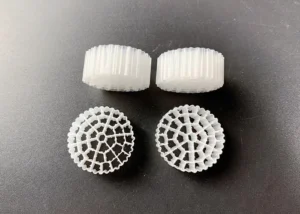
The screen is the metal barrier at the outlet of your reactor. Media is the living part of an MBBR system — the plastic carriers where bacteria grow — so if the screen lets it wash out, you don’t just lose plastic, you lose treatment capacity, and you end up buying more media to top the tank back up. MBBR media washout has a few classic causes and failure modes, and the screen is at the heart of most of them.
SS304 vs SS316 vs SS316L: Which Stainless Steel Do You Need?
The first decision — and the one that costs you if you get it wrong — is the steel. All three are stainless, but they are not the same:
- SS304 — the everyday stainless. Handles normal wastewater very well and costs the least. If your water is fairly standard, this is usually enough.
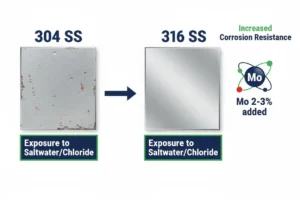
- SS316 — has a little molybdenum added, which makes it shrug off salt and chlorides far better. This is the pick for anything with salt in it: seawater, marine systems, salt-laden industrial water, and aquaculture.
- SS316L — the “low-carbon” version and the most corrosion-resistant of the three. For the harshest duty — high chlorides, strong acids, aggressive chemical loads — this is the one.
The practical difference shows up in lifespan: in the right water, any of the three lasts years. In the wrong water — say SS304 in a salt-laden stream — pitting starts, the steel weakens, and a screen you expected to last a decade starts failing in two. That’s why the grade question comes first.
Match the Steel to Your Water
The rule is simple: choose the steel to match what’s in your water, not what’s cheapest. Here’s the starting point:
| Your water | Steel |
|---|---|
| Normal industrial or municipal wastewater, low chlorides | SS304 |
| Salt water, marine systems, RAS aquaculture, chloride-laden industrial water | SS316 |
| High chlorides, strong acids, aggressive chemicals | SS316L |
One common trap: if you run a RAS system with brackish or marine water, standard stainless corrodes far faster than in fresh water. Salt attacks the steel, and a corroded screen eventually lets media slip past. If your water carries salt, that alone should move you to SS316.
What Slot Size Keeps Your Media In the Tank?
Once the steel is settled, the slot size is the second number that matters. The rule is simple: the slot must be smaller than the smallest dimension of your media, or media slips through. But make it too tight and the screen chokes the flow. Here’s the practical starting point:
| Your media | Media size | Recommended slot |
|---|---|---|
| K1 | 11 × 7 mm | ~4–5 mm |
| K3 | 25 × 10 mm | ~6–8 mm |
| K5 | 25 × 4 mm | ~3 mm |
| Biochip | 30 × 1.1 mm (chip) | ~3–4 mm |
If you’re still deciding between K1 and K3 for your system, our K1 vs K3 comparison covers which media fits your water — the slot table above follows from that choice.
Cylindrical or Flat-Panel: Which Shape Fits Your Reactor?
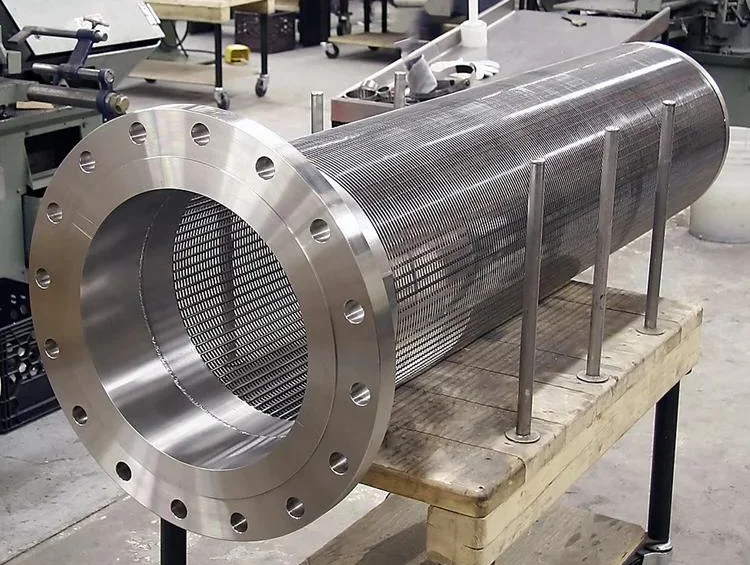
Screens come in two basic shapes. A cylindrical screen fits around your outlet pipe — a clean, common choice, especially when you’re retrofitting an existing tank. A flat-panel screen mounts across the outlet zone — often simpler to install in a new build or across a wide tank opening. Both come in the stainless grades above; the shape is mostly about your tank, not your water.
How Big a Screen Do You Need?
Sizing is the last piece. You want enough screen area that water flows freely without building up pressure, and enough coverage that media can’t find a gap around the edges. For an existing tank, measure the outlet area and match the screen to it — in most retrofits the outlet structure dictates the size. For a new build, the screen size follows from your design flow and tank layout; you can run the numbers with our MBBR sizing method if you want to check it yourself.
Don’t forget the fittings. Screens connect to your outlet with flanges or mounting frames. When you order, matching the connection to your existing piping saves a headache at installation — a small detail, but it’s where retrofits usually stumble.
The Bottom Line: Get These Four Right and You’re Set
Pick the steel for your water, the slot for your media, the shape for your tank, and the size for your flow — and the retention screen is a set-and-forget part for years. Get the steel wrong and it corrodes; get the slot wrong and media leaks. Neither is a fun call-out, and both are easy to avoid up front.