K1 or K3? If you’re buying MBBR media — or swapping an existing system over to a different carrier — it’s usually one of the first questions. In a supplier photo the two look almost identical, the prices are close, and every supplier has a favourite. But they are not interchangeable. The right one depends on what’s in your water.
Here’s the short version before we dig in: K1 gives you more treatment capacity per cubic meter of media and is the workhorse for aquaculture and cleaner-water systems. K3 resists clogging from fats, oils, and solids — which is why food, beverage, and pulp plants reach for it. If you run a RAS, a small plant, or a food & beverage facility, one of these two is very likely your answer. Match the media to your wastewater, and you’ll get more treatment for your money.
What’s the Difference Between K1 and K3 MBBR Media?
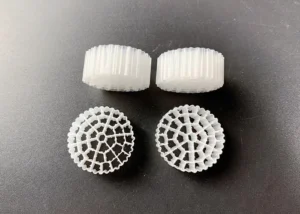
Both are small plastic carriers, made from 100% virgin HDPE, that give bacteria a surface to grow on inside a treatment tank — the moving bed turns the tank into a living filter. The difference is size and shape, and that drives everything else.
K1 is the small one. About 11mm long — roughly the size of a grain of rice. Its small cylindrical body is packed with surface, which is what makes it so efficient.
K3 is much bigger. About 25mm long — closer to a large olive or a short pen cap — with a big, open hollow interior.
| K1 | K3 | |
|---|---|---|
| Size | 11 × 7 mm (rice-sized) | 25 × 10 mm (olive-sized) |
| Surface area per m3 | ~900 m2 | ~650 m2 |
| Interior | 4 small channels | 19 large channels |
| Pieces per m3 | ~930,000 | ~118,000 |
| Material | 100% virgin HDPE | 100% virgin HDPE |
| Known for | RAS & clean-water workhorse | Resisting clogging in food & pulp wastewater |
Both have the same long lifespan — good virgin HDPE media keeps working for 10–15+ years in normal operation, which is covered in more depth in our guide to MBBR media lifespan. The real question isn’t how long they last — it’s which one treats your water better.
Which Media Gives More Treatment Capacity: K1 or K3?
Bacteria need surface to grow, and more surface means more bacteria — which means more treatment per cubic meter of media. On that front, K1 is the stronger performer.
K1 packs about 900 square meters of surface into every cubic meter of media — roughly a third more than K3’s 650. It also helps that the pieces are tiny: around 930,000 of them fit in a single cubic meter, each one a small floating home for biofilm. In clean water — where clogging isn’t a concern — K1 generally gives you more capacity for the same volume of media, and more capacity per dollar.
That’s why K1 is the default for RAS, aquaculture, and smaller treatment systems: the water is relatively clean, so you want maximum surface, and K1 delivers it.
K1 vs K3: Which Handles Fats, Oils, and Solids Better?
This is where K3 earns its place — and why it’s not simply a “worse” version of K1.
K3’s interior is one big open space with wide channels. When your wastewater carries fats, oils, grease, or fibrous solids — think food, beverage, dairy, brewery, or pulp and paper — those open channels let the water flow straight through instead of gumming up. Small carriers like K1 have narrow channels, and in greasy or fibrous water those channels clog. Biofilm grows thick, flow slows, and the media starts treating less than it should.
In other words: if your water is the kind that clogs things, K3 keeps running while K1 spends its life fighting blockages. If you’ve ever dealt with a system that kept losing performance to fouling, K3 is often the fix. Our guide to MBBR media washout and clogging covers why that happens in more detail.
K1 or K3: Which One Should You Choose?
Here’s a practical shortcut based on the situations we actually see in the field:
| Your situation | Pick |
|---|---|
| Small packaged treatment plants (compact STPs) | K1 |
| RAS / aquaculture biofiltration | K1 |
| Clean industrial wastewater, low solids | K1 |
| Food, beverage, dairy, or brewery effluent | K3 |
| Pulp & paper, high solids or fibrous water | K3 |
| You keep fighting clogging or biofouling | K3 |
The question to ask isn’t “which one is better” — it’s “what’s in my water?” Clean, normal water points to K1 for maximum capacity. Greasy, fibrous, clog-prone water points to K3. If you’re in between, it’s worth working through a proper media selection process before you commit to a fill.
If your wastewater is extremely high-load — chemical, pharmaceutical, leachate — the conversation moves past K1 and K3 to K5 or Biochip. And in aquaculture, the choice is really about species: our RAS media guide breaks that down species by species.
How Much K1 or K3 Media Will You Need?
One thing that surprises first-time buyers: because the pieces are so different in size, a cubic meter of K1 holds roughly 930,000 pieces while a cubic meter of K3 holds about 118,000. Media is quoted by volume (per m³), so what matters is how many cubic meters you fill — not the piece count.
Both are typically filled to around 30–50% of the empty tank volume, depending on the load and the aeration you have. If you want a number for your specific tank, send us your tank size and wastewater type and we’ll work out the fill and the quantity for you — usually within 24 hours. You can also run the numbers yourself using the MBBR sizing method we publish.
Conclusion
K1 packs more treatment capacity into every cubic meter and is the workhorse for aquaculture and cleaner-water systems. K3 resists clogging from fats, oils, and solids — the pick for food, beverage, and pulp wastewater. Same virgin HDPE, same long lifespan, different jobs. Match the media to what’s in your water, and you’ll get more treatment for the volume of media you buy.