MBBR Mixers: Purpose, Selection & Installation Guide
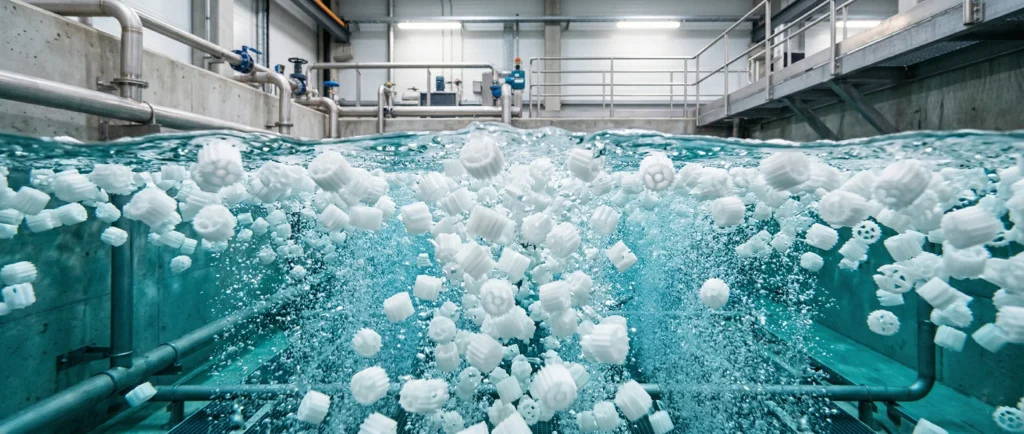
In an MBBR system, aerobic zones (with aeration) keep media fluidized naturally through rising bubbles. But anoxic and anaerobic zones — where denitrification and phosphorus removal happen — have no aeration. Without mixing, the media settles to the bottom, reducing effective reactor volume and treatment capacity.
MBBR mixers provide the gentle, uniform flow needed to keep media suspended in these zones, ensuring the entire tank volume is biologically active.
Why MBBR Mixers Are Essential
In a typical MBBR process layout:
- Aerobic zone → Media fluidized by aeration diffusers (fine or coarse bubble)
- Anoxic zone → No aeration (needed for denitrification) → Mixer required
- Anaerobic zone → No aeration (needed for phosphorus release) → Mixer required
What happens without a mixer? MBBR media settles in stagnant zones. The effective treatment volume drops — sometimes by 30–50%. Uneven biofilm growth and localized overloading follow. Many MBBR performance issues trace back to inadequate mixing, not the media itself.
Key Specifications
Material
0.75 – 7.5 kW (select based on tank volume)
Custom configurations available
Material
SS316 shaft and hardware
Ductile iron or SS304 body
EPDM / FKM seals
Shape
High-efficiency hydrofoil design
2-blade or 3-blade options
Anti-fouling coating optional
Mounting
Side-entry (most common)
Submerged guide rail system
Flanged / bracket mounted
MBBR Mixer Selection Guide
Choosing the right mixer depends primarily on tank geometry and media fill ratio. Use this table as a starting point:
| Tank Volume (m³) | Recommended Power | Typical Flow Rate | Application |
|---|---|---|---|
| 10 – 50 | 0.75 – 1.5 kW | 3 – 8 m³/min | Small MBBR units, package plants, RAS |
| 50 – 200 | 1.5 – 3.0 kW | 8 – 20 m³/min | Medium municipal / industrial reactors |
| 200 – 500 | 3.0 – 5.5 kW | 20 – 40 m³/min | Large municipal / industrial reactors |
| 500 – 2000 | 5.5 – 7.5 kW | 40 – 80 m³/min | Large-scale WWTP, multi-reactor systems |
Installation Considerations
- Position: Install the mixer at 1/3 to 1/2 of tank depth for optimal flow circulation.
- Angle: Aim the mixer slightly upward (10–15°) to keep media from settling in corners.
- Multiple mixers: For rectangular tanks longer than 6 m, consider two mixers on opposite sides to eliminate dead zones.
- Guide rail system: Allows the mixer to be lifted out for maintenance without draining the tank.
MBBR Mixer vs Standard Submersible Mixer
Categories
Get the Perfect Media Match for Your System
Don’t guess your filling ratio. Simply share your project details—wastewater type, flow rate, and target effluent quality—and we’ll calculate the most efficient, cost-effective media solution for you.