Buying an aeration system — or just the replacement parts to keep an old one running — usually turns into a vocabulary exercise. Diffuser, membrane, check valve, drop pipe, SOTE, head loss. Suppliers throw these words around like everyone grew up inside a treatment plant.
Here’s the good news: a diffused aeration system only has a handful of real parts. Once you know what they are, and the few numbers on a datasheet that actually matter, comparing quotes stops being guesswork. That’s what this guide covers — the parts, in plain English, and what to ask before you hand over a purchase order.
What Parts Make Up an Aeration System?
Every aeration system does the same job: push air to the bottom of a tank and release it as bubbles. Strip away the jargon and that job needs only four pieces:
- The blower. The air source, sitting outside the tank. It’s the engine of the whole system, and usually the biggest energy user on site.
- The piping. Air mains, drop legs, and fittings that carry air from the blower into the tank.
- The diffusers. The parts on the tank floor that turn that air into bubbles.
- The membrane (on fine bubble diffusers). The replaceable “skin” that creates the fine bubbles — and the part you’ll buy again and again.
That’s the anatomy. Everything else on a parts list — check valves, saddles, throttle valves — just helps one of these four do its job. The sections below explain each one and what to look for when buying.
What Is an Aeration Diffuser — and Which Type Should You Use?
The diffuser is the part at the bottom of the tank that releases the air. It’s the heart of the system, and it comes in three common shapes:
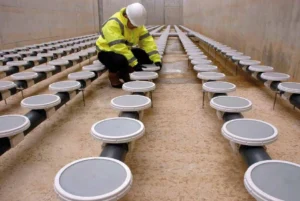
Fine bubble disc diffusers are flat, round discs that sit on the tank floor. They produce a dense cloud of very small bubbles, which puts more oxygen into the water for every unit of air. They’re the default choice for activated sludge, SBR, and MBBR tanks — anywhere biological treatment is the job.
Fine bubble tube diffusers do the same thing in a long cylinder shape. Tubes distribute air more evenly across long, narrow tanks, which is why they’re often preferred for larger basins and MBBR systems.
Coarse bubble diffusers release big bubbles through larger openings. They’re far less efficient at transferring oxygen, but they mix the water hard and almost never clog — so they’re the pick for grit chambers, equalization basins, sludge tanks, and anywhere solids or grease would blind a fine bubble membrane.
| Diffuser type | Best for | The trade-off |
|---|---|---|
| Fine bubble disc | Biological treatment — ASP, SBR, MBBR | Best oxygen efficiency, needs periodic membrane replacement |
| Fine bubble tube | Long, narrow tanks and MBBR grids | Even air distribution, still needs membrane replacement |
| Coarse bubble | Grit chambers, equalization basins, sludge tanks | Almost zero maintenance, but uses far more energy |
If you’re weighing which type fits your plant, our fine bubble vs coarse bubble diffuser comparison covers the full decision.
What Is the Diffuser Membrane — and Why Is It the Part You’ll Keep Replacing?
Fine bubble diffusers work because of a thin rubber membrane stretched over the diffuser body. Air pushes through thousands of tiny slits in the membrane, and that’s exactly what makes the bubbles so small.
The catch: the membrane is a consumable. After a few years of operation, the rubber hardens, loses elasticity, and stops transferring oxygen efficiently. When that happens, you don’t replace the whole diffuser — just the membrane. That’s why replacement diffuser membranes are stocked as spare parts, and why it’s worth checking, before you buy any fine bubble system, that membranes are actually available for that model. Some suppliers lock you into an exclusive membrane — ask about that up front.
Material matters. EPDM is the workhorse — cheap and reliable in most municipal and industrial wastewater. Silicone handles oils and aggressive chemicals better and lasts longer in those conditions, but costs more. Your wastewater’s chemistry should make this decision, not the sales brochure.
What Are Check Valves on Diffusers — and Why Do They Matter?
A check valve stops one specific, expensive problem: sludge flowing backwards into the air pipes when the blower shuts off.
Here’s what happens without one. The blower stops, the pressure in the pipe drops, and the weight of the water outside pushes tank liquor up through the diffuser into the air line. That sludge sits in the piping, dries, and blocks air to the whole grid. Older ceramic diffusers were notorious for this — the classic reason plants had to drain basins just to unclog their aeration.
Modern EPDM membranes largely solve this by design: the tiny slits close up under water pressure the moment air stops, acting as their own check valve. That’s why membrane diffusers replaced ceramic in most applications. If you’re running intermittent aeration — air on, air off, like an SBR or anoxic zones — this self-sealing behaviour matters even more.
What Goes Into Aeration Piping: The Parts Between the Blower and the Tank
This is the part of the system most buyers ignore until something leaks. The piping — sometimes called the “air header” — runs from the blower to the tank and then down into the water to reach the diffusers. You’ll typically see:
- Air mains and headers — the main pipes distributing air around the site.
- Drop legs — vertical pipes carrying air down to the diffuser grid at the bottom.
- Saddles or supports — the brackets holding pipe and diffusers in place.
- Throttle valves — small valves that let you balance airflow between zones, so one part of the tank doesn’t hog all the air.
- Couplings and fittings — the connectors, worth buying from the same supplier so sizes and threads actually match.
Two practical buying rules. First, don’t mix-and-match pipe components from several vendors without checking thread sizes — “nearly fits” leaks. Second, when replacing part of an existing grid, make sure new diffusers match the old system’s airflow resistance; otherwise air takes the path of least resistance and your new diffusers get nothing. The diffuser comparison guide covers that trap in detail.
What Specs Should You Actually Care About on a Diffuser Datasheet?
You don’t need to be an engineer to read a diffuser datasheet. Out of all the numbers on the page, four tell you almost everything:
- SOTE (standard oxygen transfer efficiency). How much of the oxygen in the air actually ends up dissolved in the water. Higher is better — it means you run the blower less. Fine bubble systems typically land in the 15–40% range; coarse bubble is far lower.
- Airflow range. How much air each diffuser is designed to handle, usually in m³/h. Buy too few diffusers and you’ll push them past their rated range, which wastes energy and wears the membrane out early.
- Head loss (pressure drop). How hard the blower has to push. Lower is easier on the blower — but if you’re replacing diffusers one-for-one, make sure the number matches the existing system.
- Membrane material. EPDM, silicone, or polyurethane, matched to your wastewater as discussed above.
A supplier that hands you these numbers in a proper datasheet is usually a supplier worth talking to. One that answers with “high efficiency, best quality” and nothing to verify — treat that brochure with suspicion. Real data beats adjectives, every time.
What to Ask Before You Order an Aeration System
Before you commit, run through this short checklist:
- Can you show me a datasheet with SOTE, airflow range, and head loss — not marketing words?
- Are replacement membranes available for this exact model, and at what price?
- Does the membrane suit my wastewater — grease, hardness, chemicals?
- What’s the expected membrane life, and how do I know when it’s time to replace it?
- Do you supply the piping, saddles, and valves too, or will I be mixing suppliers?
- What’s the lead time — both for the system and for future replacement membranes?